The capital of Malaysia is one of Southeast Asia's easiest cities to do business in — English is widely spoken, the infrastructure is modern, and the city is highly digital — but a few local specifics are worth knowing in advance.
Kuala Lumpur has quietly become one of Asia’s most practical and rewarding cities for business travel, serving as a one of the key destinations for representatives of the oil and gas industry, the banking sector and the financial services sector. It’s a genuinely cosmopolitan capital — multicultural, well-connected and cheaper than almost any comparable destination in the region. Whether you’re here for a single meeting or a full week of events, this guide covers everything you need to arrive organised and make the most of your time.
Discover more of Tumodo corporate travel guides.
Before you go
Visa and entry requirements
Don’t confuse the arrival card with the visa. They are separate requirements and most travellers need both.
Arrival card
The Malaysia Digital Arrival Card (MDAC) is mandatory for almost all foreign visitors and must be submitted online within three days before arrival. It is free, single-use (a new one is required for every entry) and available only through the official Immigration Department portal. Ignore any site that charges a fee — those are scams.
Once submitted, you receive a QR code; keep it handy, as airlines increasingly check it at check-in and there is no MDAC desk on arrival. Singapore citizens, diplomats and Malaysian permanent residents are among the few exempt.
Visa
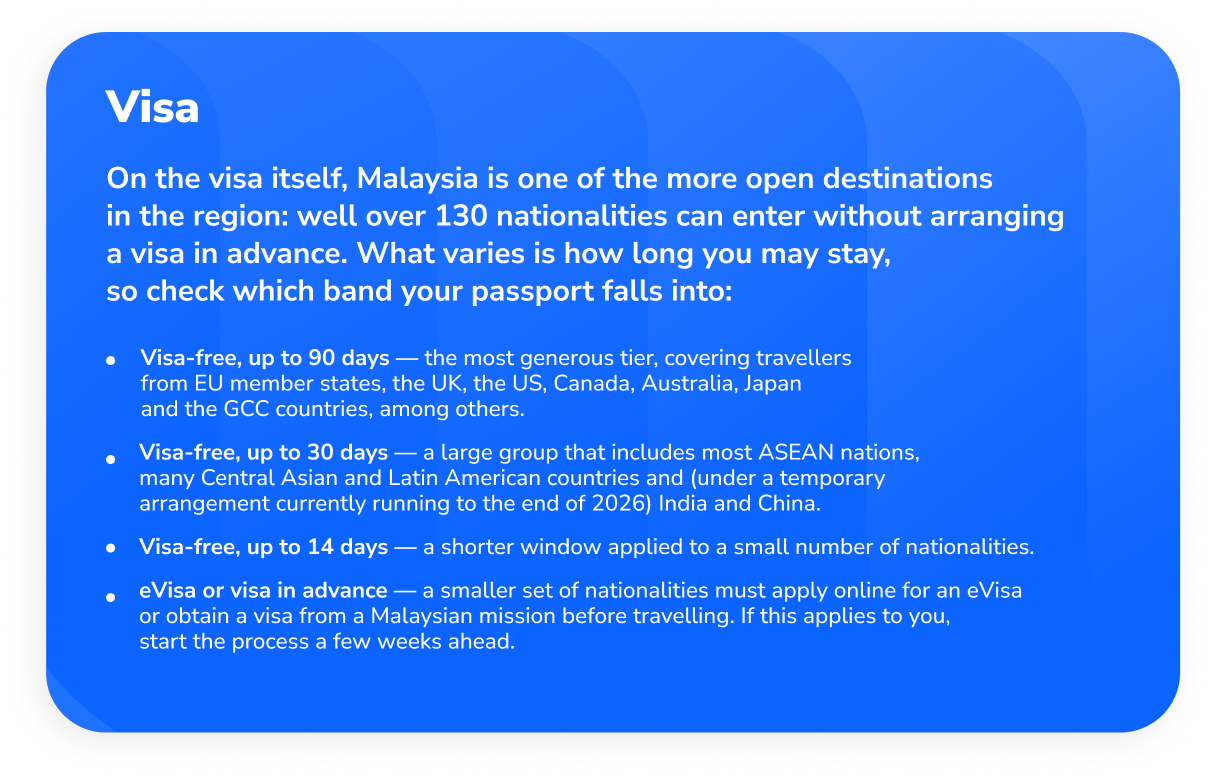
Because these bands are adjusted from time to time, confirm your own entitlement against the official Immigration Department list before you book. Your passport must be valid for at least six months beyond your travel dates.
Be ready to show a return or onward ticket and possibly proof of accommodation or sufficient funds. At the Kuala Lumpur International Airport, autogates now serve travellers from 60+ countries, so clearance is often a matter of seconds.
Time zone and scheduling
Malaysia runs on Malaysia Time (MYT), UTC+8, with no daylight saving — so the offset is constant year-round. It's the same time as Singapore, Hong Kong and Beijing. Build a buffer day if you're arriving from Europe or the Americas, since you'll lose most of a working day to the flight and the time shift.
The standard workweek in Kuala Lumpur is Monday to Friday, with office hours typically around 9:00 to 18:00. (A handful of states keep a Friday–Saturday weekend, but the federal capital does not.)
The one scheduling nuance to respect: Friday midday. Many Muslim colleagues take an extended lunch break for Friday prayers, roughly 12:15 to 14:45, so avoid booking meetings or lunches in that window. If your trip overlaps with Ramadan, expect shortened business hours and adjusted meal timing.
Money and payments
The currency is the Malaysian Ringgit (MYR / RM). Kuala Lumpur is overwhelmingly cashless, built around DuitNow QR and e-wallets — Touch 'n Go eWallet, GrabPay, Boost and ShopeePay.

Touch 'n Go now accepts international phone numbers for registration, so you can set it up before landing; it's useful for the LRT/MRT (types of urban rail), convenience stores and street food.
Cards (Visa and Mastercard) are accepted in hotels, malls and most restaurants; American Express is less reliable. Still, carry some cash for smaller hawker stalls, markets and the occasional vendor that's QR-only on a local app. ATMs are plentiful — notify your bank of travel dates to avoid blocks.
Tipping is not customary; mid-range and upscale venues usually add a service charge (around 10%) plus sales and service tax, so check the bill before adding anything.
Internet and apps
Connectivity is excellent, with nationwide 5G. The smart move for a short trip is an eSIM activated before departure: since February 2026, buying a physical SIM at the airport involves passport and biometric registration that can eat 20 minutes of your arrival. An eSIM has you online the moment you land — ready to book a ride and message your hotel.
Here are some useful apps:
- Grab — the regional super-app for ride-hailing and food delivery; the default way to get around and usually cheaper than street taxis.
- Touch 'n Go eWallet — payments and transit.
- WhatsApp — the primary channel for local communication; hotels, drivers and counterparts will often reach you here.
- Google Maps (with offline maps downloaded) and Waze for navigation if you're driving.
Accommodation: rules and tips
For business, location beats everything because Kuala Lumpur traffic is heavy. Three areas work well: KLCC (around the Petronas Towers — premium hotels, corporate offices), Bukit Bintang (central, walkable, dining and shopping) and KL Sentral (the transport hub, with the KLIA Ekspres train reaching the airport in about 28 minutes). Prioritise a hotel within walking distance of your meetings or close to an MRT/LRT station to stay out of gridlock.
A few practicalities: check-in is typically 15:00 and check-out is 12:00; you'll need your passport at the front desk. Foreign guests pay a flat tourism tax of 10 MYR per room per night, usually on top of sales and service tax and any service charge — confirm whether the quoted rate is inclusive so the final bill doesn't surprise your expense report.
Many hotels handle airport transfers and guest communication via WhatsApp, so save the property's number on arrival. Keep a copy of your booking confirmation accessible, since the MDAC and check-in both ask for your local address.
Business etiquette and local norms
Kuala Lumpur is multicultural — Malay, Chinese and Indian communities all shape its business culture — so adaptability matters more than memorising a single rulebook.
A warm handshake is standard, but some Muslim counterparts, particularly women, may prefer not to shake hands across genders. A slight nod or hand over the heart is a gracious alternative. Exchange business cards with both hands (or the right hand) and read a card before putting it away.
Titles carry weight: use Malaysian honorifics such as Tan Sri, Datuk and Dato' when present; otherwise, Encik (Mr), Puan (Mrs) and Cik (Miss) are safe. Use the right hand for giving and gesturing and avoid pointing with a single finger.
Business is relationship-led: expect some small talk before substance, polite and indirect communication and a strong instinct to avoid causing loss of face. Decisions involve hierarchy and take time, so patience reads as professionalism — but be punctual yourself. Dress conservatively and smartly despite the heat: lightweight business attire with modest coverage.
If you bring gifts, keep them modest and avoid alcohol or pork-related items for your Muslim counterparts. At meals, let your host lead, expect halal options as standard and avoid scheduling working lunches over the Friday prayer window.
How to get to Kuala Lumpur
International travel
Air connections
Almost all international travellers arrive at Kuala Lumpur International Airport (KLIA), the country's main gateway and one of the region's busiest hubs, located about 45–50 km south of the city centre. The airport has two terminals:
- Terminal 1 — used by full-service carriers;
- Terminal 2 — the base for low-cost airlines.
They are several kilometres apart and linked by train and shuttle bus, so it's worth knowing which terminal your flight uses — especially on the return leg.
Malaysia Airlines is the national flag carrier (oneworld alliance), operating the widest full-service long-haul and regional network from Terminal 1. AirAsia is one of the world's largest low-cost carriers and the busiest operator at KLIA by number of departures, based at Terminal 2. Batik Air is the third-largest operator and a useful mid-market option.
Connecting flights
If there's no convenient direct flight from your home city, Kuala Lumpur is easy to reach with a single connection. The most efficient one-stop routings usually run through the big network hubs that feed Southeast Asia: the Gulf carriers (via Dubai, Doha, or Abu Dhabi), Singapore, Bangkok, Hong Kong, Istanbul and major Indian and Chinese gateways. From most of these, the onward leg to Kuala Lumpur is short.
When to book
If the dates of the business trip have been finalised and all the necessary approvals have been obtained, the sweet spot for booking is 2–3 weeks in advance, as this increases the likelihood of securing tickets and a hotel room at a lower price. Choose fares that allow changes or refunds, as non-refundable fares may lead to losses if plans change. For peak periods, book even earlier.
Those peak periods are worth flagging on the calendar, because they push up both fares and occupancy. 2026 is "Visit Malaysia Year," a major tourism push that is expected to keep demand high throughout the year. On top of that, watch for regional holiday surges — Chinese New Year (late January to February), the Ramadan and Hari Raya / Eid period and
Malaysian and regional school holidays — when flights fill and prices climb. If your trip coincides with a large conference or trade event in the city, book flights and hotels as early as possible, since both get scarce.
From Kuala Lumpur airport (KUL) to the city centre
By train
The quickest way to get from Kuala Lumpur International Airport to the city centre is by the KLIA Ekspress train. In just 28 minutes, with no stops, you’ll reach the city’s main transport hub — KL Sentral station. A ticket costs 55 MYR ($14).
By bus
The bus is cheaper — 15 MYR ($4). If there’s no traffic, the journey to KL Sentral takes an hour. Buses leave the airport every half an hour, and the ticket offices are located there. You can check the timetable on the website.
By taxi or car transfer
A car is the main means of transport in Kuala Lumpur, though getting to the city centre by ground can take longer because of heavy traffic.
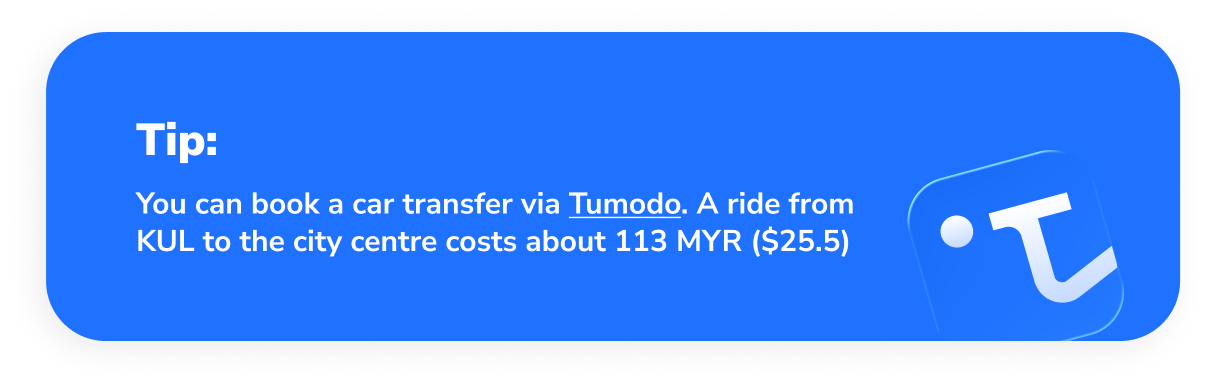
On average, a standard GrabCar from KLIA to central Kuala Lumpur costs around RM75–RM90 ($19 – 23) during off-peak hours.
Getting around Kuala Lumpur
Traffic in Kuala Lumpur is genuinely heavy, particularly during morning and evening rush hours (roughly 7:30–9:30 am and 5:30–7:30 pm). Building a buffer into any meeting schedule that requires ground transport is strongly advised. The good news is that the city’s rail and ride-hailing options are reliable and cheap.
Grab
Grab is the default way to get around Kuala Lumpur. The app works like Uber, shows the fare upfront and is almost always cheaper and more reliable than street taxis. Download it before arrival and top up via card in-app. It’s also the easiest way to get between business districts when the MRT doesn’t connect the dots directly.
MRT, LRT and Monorail
For journeys within the city centre, the rail network is fast and avoids traffic entirely. The key lines for business travellers are the Kelana Jaya LRT (linking KL Sentral to KLCC and Ampang Park), the Kajang MRT (serving Bukit Bintang and linking to KL Sentral) and the KL Monorail (running through Bukit Bintang and connecting to KL Sentral). The TRX MRT station serves the new Tun Razak Exchange financial district directly. Fares are low — most journeys within the city cost between 1.5 MYR and 5 MYR. Touch ‘n Go is the easiest way to pay; it works across all lines.
Driving and parking
Renting a car is rarely worth it for a short business trip — parking in the city centre is limited, and navigation during peak hours is stressful. If you do drive, use Waze rather than Google Maps; it is better calibrated to Kuala Lumpur’s traffic patterns and road closures. Most hotels and office buildings have paid parking, typically charged by the hour.
Where to stay in Kuala Lumpur
The properties below span a range of budgets and styles — from compact, well-located apartments for solo business travellers to larger serviced residences suited to extended stays. All are bookable through Tumodo. Location is key in Kuala Lumpur, given the traffic, so each entry notes proximity to public transport and key business districts.
PARKROYAL Serviced Suites Kuala Lumpur
Location
PARKROYAL Serviced Suites Kuala Lumpur sits in the heart of the Golden Triangle — Kuala Lumpur’s main business and entertainment district — adjacent to Jalan Alor and within easy walking distance of Pavilion Kuala Lumpur (8 minutes) and Bukit Bintang. Raja Chulan Monorail Station is just 300 metres away, connecting guests directly to the broader rail network. Suria KLCC and the Petronas Twin Towers are a 19-minute walk or a short Grab ride. The location puts the city’s main corporate offices, restaurants and transport links all within close reach.
At the hotel
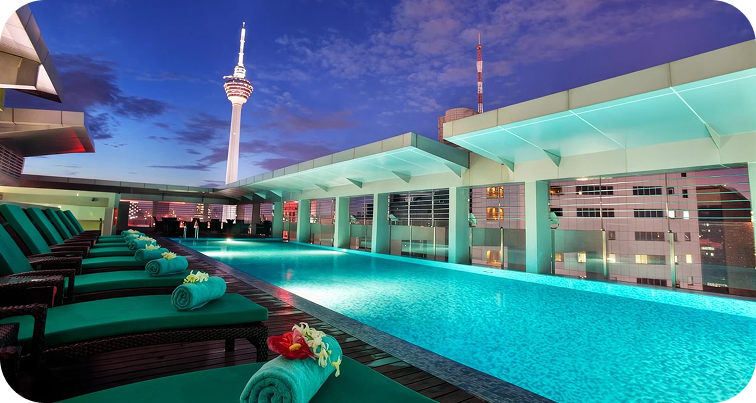
The hotel offers 286 spacious, fully furnished apartments across 30 floors, making it a strong choice for both short and extended business stays. Each suite is equipped with a kitchenette with refrigerator and stovetop, air conditioning, 40-inch flat-screen TV, work desk, safe and complimentary Wi-Fi.
The hotel features a business centre, meeting rooms and conference facilities — available on site for those needing a professional space without leaving the building. Additional amenities include two outdoor swimming pools, a 24-hour fitness centre, sauna, steam room and a children’s pool. A shuttle service to selected business areas and shopping malls is provided, and free private parking is available on site. Continental breakfast is served daily.
The Majestic Hotel Kuala Lumpur, Autograph Collection
Location
The Majestic Hotel occupies a landmark position opposite Kuala Lumpur’s iconic Moorish railway station on Jalan Sultan Hishamuddin, close to Merdeka Square and the National Museum. KL Sentral is a five-minute drive away, and a complimentary hotel shuttle runs to KL Sentral every 30 minutes from early morning to midnight — making airport connections and cross-city travel straightforward. While the location is slightly removed from the Golden Triangle, it suits guests attending government or legal meetings in the civic district, and the shuttle largely eliminates the inconvenience.
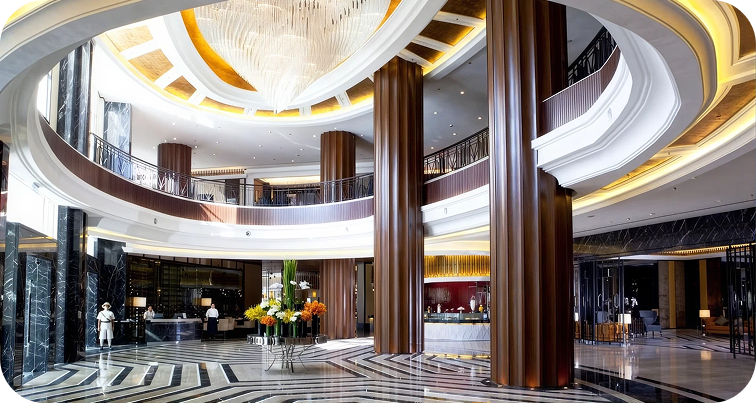
At the hotel
Originally built in 1932 and restored to its colonial grandeur, The Majestic is the city's only heritage hotel and a Marriott Autograph Collection property. It offers 300 rooms and suites across two wings: the historic Majestic Wing, housing 47 butler-service suites in an authentic Art Deco setting, and the modern 15-storey Tower Wing with 253 contemporary Deluxe Rooms and Junior Suites.
For business travellers, the hotel’s event facilities are substantial — 13 meeting rooms plus a pillarless Grand Ballroom seating up to 1,200 guests. Additional facilities include two outdoor swimming pools, a spa, a 24-hour gym and the signature Colonial Café. Valet parking and an airport shuttle are available.
Ascott Sentral Kuala Lumpur
Location
Ascott Sentral is positioned within a seven-minute walk of KL Sentral, giving guests direct rail access to the airport and all major business districts. NU Sentral Shopping Mall is 450 metres away, Little India is a short walk, and the Muzium Negara MRT station is also nearby. Petronas Twin Towers are roughly a ten-minute ride by Grab. The KL Sentral corridor is a growing commercial zone, home to several multinational offices and well placed for meetings across the city.
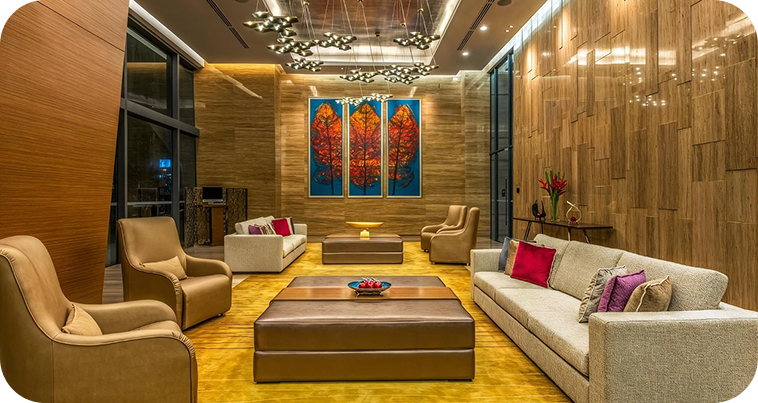
At the hotel
Ascott Sentral is a 157-room residence well suited to both short visits and longer corporate stays. Apartments feature contemporary furnishings, kitchenettes for self-catering, premium bedding, a pillow menu, and large en suite bathrooms with designer fixtures. Flat-screen satellite TV, free Wi-Fi and city views are standard across room types.
For business use, the hotel offers dedicated conference and function rooms, a business centre, and a 24-hour multilingual front desk. Leisure facilities include an indoor pool, outdoor pool with sun terrace, fitness centre and steam room. A complimentary continental breakfast is served daily, and an on-site restaurant offers international cuisine throughout the day. Free self-parking is included, and airport shuttle service is also available.
Vivatel Kuala Lumpur
Location
Vivatel Kuala Lumpur is located on Jalan Loke Yew in the Pudu district, a few minutes by car from the city centre. Miharja LRT Station is a short walk away, providing direct connections to KLCC, Bukit Bintang and KL Sentral. Petaling Street and Merdeka Square are within a five-minute drive, and the hotel is connected to an on-site shopping mall. While not in the immediate Golden Triangle, Vivatel’s LRT access and competitive rates make it a practical choice for business travellers prioritising value and connectivity.
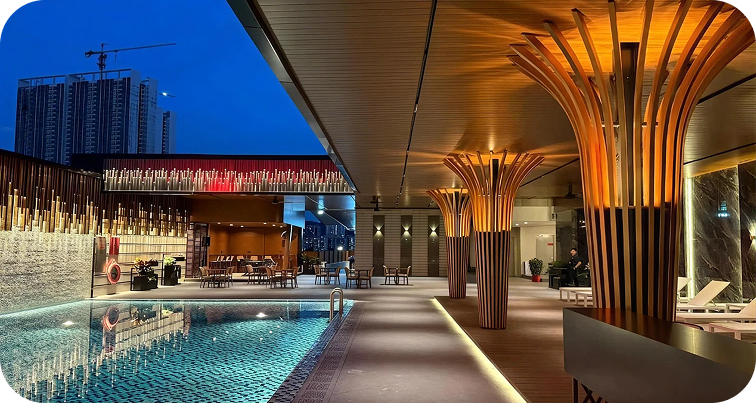
At the hotel
A contemporary hotel with 302 rooms and suites, Vivatel offers a distinctive nature-inspired design — rooms themed around water, fire, wood, earth and metal — combined with full business infrastructure. All rooms come with air conditioning, LCD TV, high-speed Wi-Fi, minibar, in-room safe and complimentary toiletries.
Event and meeting facilities include a pillar-free Grand Ballroom and four dedicated meeting rooms with a combined capacity of up to 1,000 guests. Express check-in kiosks offer added convenience on arrival. Leisure facilities include an outdoor pool, gym and spa. The Retro Lounge and Café serves Asian, international and European cuisine for breakfast, lunch and dinner, and also works well for casual working lunches or informal client meetings. Free valet parking and airport transfers (at additional charge) are available.
One-Stop Residence Hotel & Office
Location
One-Stop Residence Hotel & Office is located within Fraser Business Park in Pudu, a short distance from the city centre. MyTown Shopping Centre and Sunway Velocity Mall are within a five-minute drive, and Chan Sow Lin MRT Station is the nearest rail link. The Fraser Business Park location makes it a particularly practical base for those with meetings in the surrounding commercial zone.
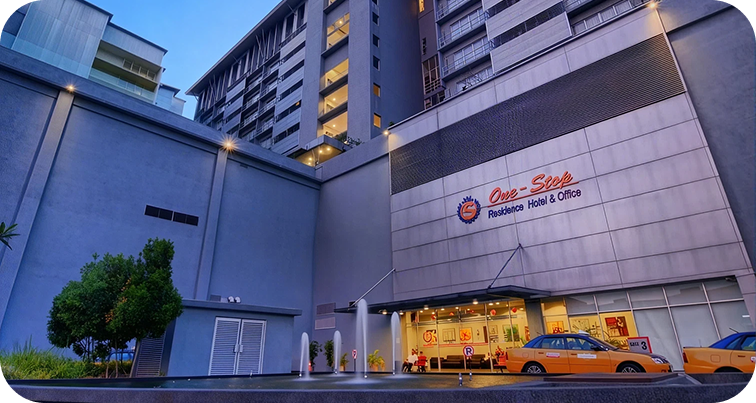
At the hotel
One-Stop Residence Hotel & Office is a 3-star aparthotel offering 209 air-conditioned rooms with a kitchenette, LCD TV, safe, coffee and tea maker, bidet, hairdryer and blackout curtains in every unit — practical, self-contained accommodation well suited to professionals on longer assignments.
True to its name, the property uniquely integrates office space within apartment units, making it a viable base for frequent business travellers or those needing a home-office setup during extended stays. A meeting room is available on site for group sessions. Shared facilities include two outdoor swimming pools, a fitness centre, and on-site dining. Paid private parking is available on site, and the airport shuttle can be arranged. Free Wi-Fi is available throughout.
Walking route through Kuala Lumpur
Kuala Lumpur on foot: colonial squares, street food and twin towers
If you have a couple of free hours between meetings, step outside and explore one of Southeast Asia's most dynamic city centres. Kuala Lumpur rewards walkers with a striking mix of colonial architecture, modern skyscrapers, bustling street markets and lush green spaces — all within a manageable distance of one another.
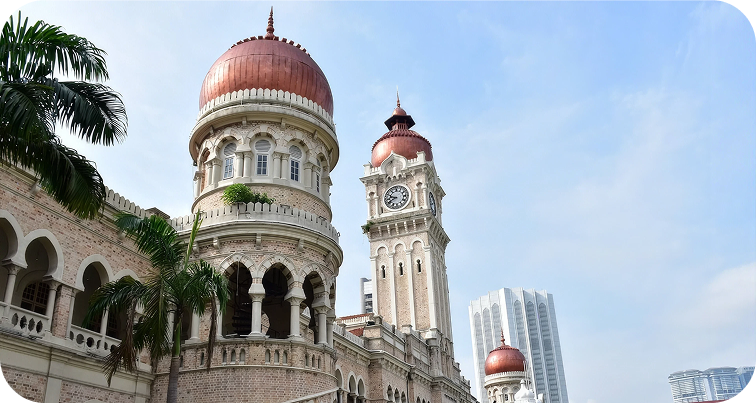
Start your walk in Merdeka Square, the symbolic heart of the city. The vast open field, framed by the Sultan Abdul Samad Building with its distinctive Moorish-inspired facade and copper domes, is where Malaysia declared independence in 1957. It's a calm and photogenic spot, especially in the morning before the midday heat sets in.
From here, head south a few minutes on foot to Masjid Jamek, one of Kuala Lumpur's oldest mosques, sitting quietly at the confluence of the Klang and Gombak rivers — the very point where the city was founded. Even if you don't go inside, the view of its pink-and-white minarets from the riverside walkway is well worth pausing for.
Continue towards Chinatown, a ten-minute walk away. Petaling Street is the lively core of this district — a covered pedestrian market lined with stalls selling street food, clothing and souvenirs. Grab a cup of strong local coffee or a bowl of char kway teow from one of the surrounding hawker spots. It's noisy, colourful and full of life.
From Chinatown, take a short Grab ride (around fifteen minutes) up to the Bukit Bintang district, the commercial and entertainment hub of modern Kuala Lumpur. Stroll along Jalan Bukit Bintang past gleaming malls, pavement cafés and flagship stores. A short walk further brings you to Jalan Alor, a narrow street that transforms into one of the city's best open-air food streets come evening — satay, grilled seafood and fresh fruit are all on offer.
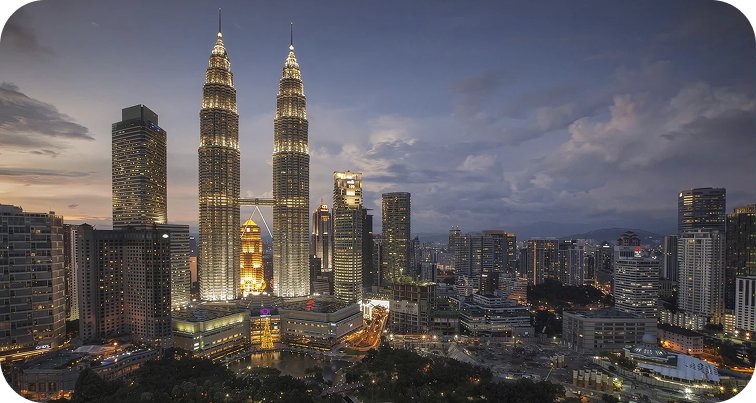
End your walk at the Petronas Twin Towers, a fifteen-minute walk or quick ride from Bukit Bintang. Once the tallest buildings in the world, the Towers remain an extraordinary sight up close, especially as the city lights come on in the early evening. The surrounding KLCC Park offers manicured gardens and a fountain show — a peaceful and impressive way to close out the day before heading back to your hotel or next commitment.
Business-friendly lunch spots in Kuala Lumpur
Kuala Lumpur's food scene is one of Southeast Asia's most exciting — a vibrant blend of Malay, Chinese, Indian and international influences, served in settings that range from elegant hotel dining rooms to intimate chef-led kitchens. Whether you're looking to impress a client or recharge quietly between meetings, the city delivers. The places below combine quality cuisine with the atmosphere that makes a business lunch feel effortless.
Cilantro
One of Kuala Lumpur's most respected fine dining institutions, Cilantro has been setting the benchmark for French-Japanese cuisine in the city for over a decade. Helmed by Japanese chef Takashi Kimura, the restaurant brings classic French dishes to life using first-rate ingredients sourced from Japan, and has been recognised in the Michelin Guide and named one of Asia's top 100 restaurants.
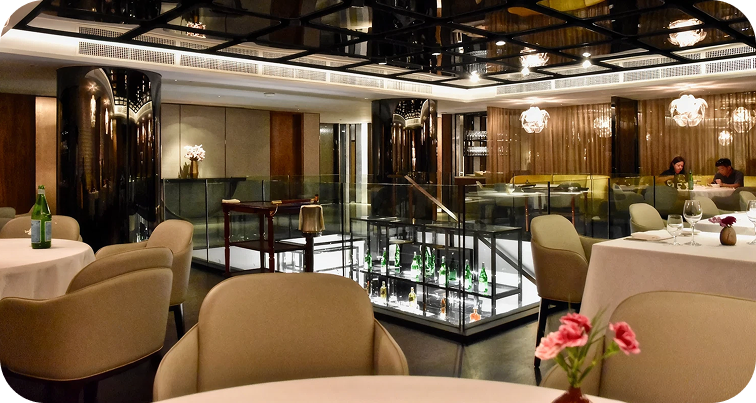
At lunch, the L'Atelier menu shifts the tone to a relaxed French bistro feel, with two and three-course set menus available Tuesday to Sunday — ideal for a refined but unhurried midday meeting. Signature dishes include the cold capellini, which changes with the seasons and Japanese Wagyu. Private dining rooms seating four to eight guests are also available, subject to minimum spend.
Dress code: smart casual — flip-flops, open top footwear, shorts and singlets are not permitted.
Shang Palace
For a business lunch rooted in Cantonese tradition, Shang Palace at the Shangri-La Kuala Lumpur is a perennial favourite among the city's corporate crowd. Set in an opulent dining room that honours the legacy of Cantonese cuisine, the restaurant offers refined dim sum alongside roasted meats, seafood specialties and curated set menus.
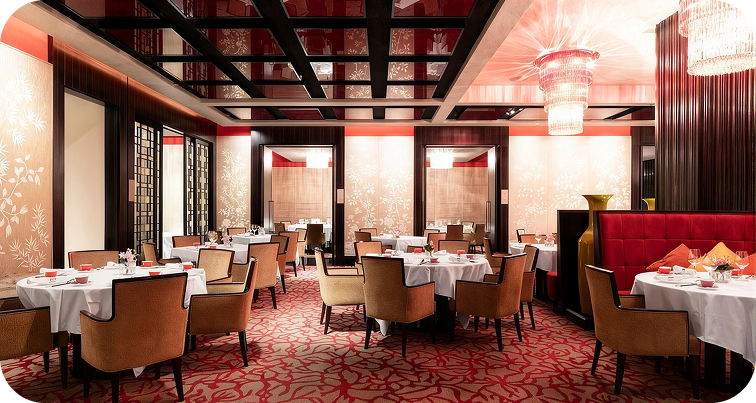
Six private dining rooms of varying sizes are available, making it an excellent venue for confidential conversations or hosting international clients who appreciate the theatre of a traditional Chinese lunch. The restaurant is halal-certified — a practical consideration when dining with varied groups in Kuala Lumpur.
Smart casual dress code is required.
Wagyu Kappo Yoshida
For something more contemporary, Wagyu Kappo Yoshida brings a uniquely impressive proposition to the Kuala Lumpur business lunch scene. A beef omakase concept by Michelin-starred Chef Junichi Yoshida, the restaurant specialises in high-grade Japanese Wagyu prepared using traditional Kappo techniques, available both à la carte and as part of curated omakase menus.
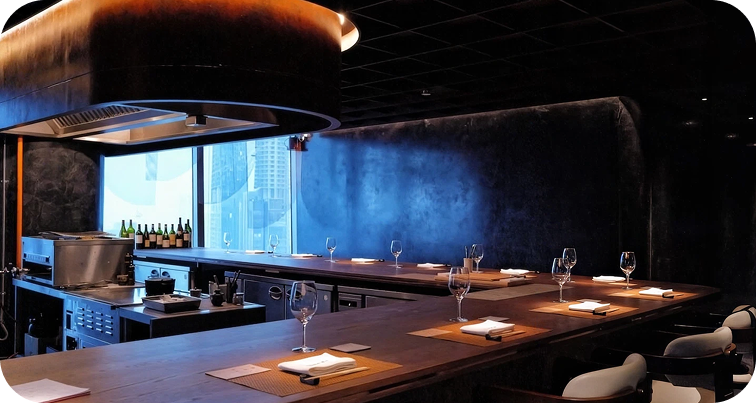
The restaurant is situated on Level 48 of a tower at Persiaran KLCC, with views to match the cooking. It's the kind of venue where the meal itself becomes the conversation — ideal for when you want to leave a lasting impression.
The restaurant also enforces a smart casual dress code.
Where to relax after work
Kuala Lumpur's evenings have a distinct energy — the heat softens, the city lights up, and some of the best views in Southeast Asia become the backdrop for a well-earned drink. Here are two spots that are well worth the visit after a long day of meetings.
SkyBar
One of Kuala Lumpur's most iconic rooftop destinations, SkyBar sits on the 33rd floor of Traders Hotel, directly beside the Kuala Lumpur Convention Centre, with unobstructed views of the Petronas Twin Towers and the city skyline beyond. Newly reimagined, the venue features a refreshed layout, elevated ambience, immersive sound and a new lineup of signature cocktails, paired with vibrant DJ sets and live band performances on selected nights.
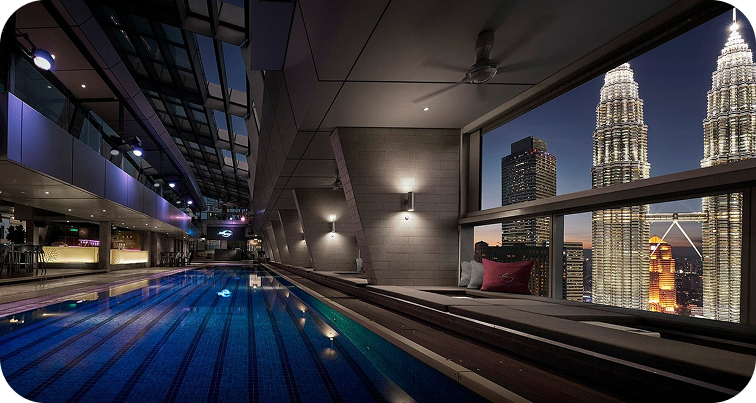
The centrepiece is a 26-metre pool that transforms the space from a daytime retreat into one of Kuala Lumpur's liveliest evening spots. Golden Hours run daily from 4:00 pm to 8:00 pm — ideal for arriving straight from the office to catch the sunset over the twin towers. Window cabana seats are available on a first-come, first-served basis with a minimum spend of 200 MYR, fully redeemable against food and drinks.
No entry fee. Dress code: smart casual. Guests under 21 are not permitted after 9:00 pm.
Vertigo
Perched on the 59th floor of Banyan Tree Kuala Lumpur, Vertigo is the city's highest rooftop bar, offering sweeping panoramic views of the Kuala Lumpur skyline — including the Petronas Twin Towers, KL Tower and, on a clear evening, the distant glow of Genting Highlands.
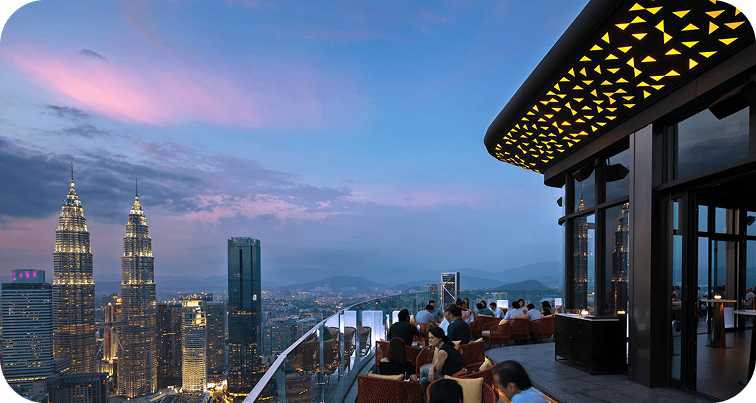
The open-air terrace has a sophisticated yet relaxed atmosphere, with Southeast Asian-inspired tapas, personalised cocktails and live DJ sets creating a vibe that's perfect for unwinding with colleagues or entertaining clients in style.
Reservations are strongly recommended and can be booked in two time slots — 6:00 pm to 9:00 pm for those wanting to catch the sunset, or 9:00 pm to midnight for a livelier evening. No entry fee applies, though a minimum spend may be required for reserved tables. Dress code: smart casual.
What to bring back for colleagues
Business trips rarely end without a small gift for the team back home. In Kuala Lumpur, the options reflect the city's rich cultural mix — from local flavours to handcrafted textiles that are hard to find anywhere else.
- Kopitiam coffee and teh tarik. Malaysian white coffee — a milder style roasted with palm oil margarine, originally from the town of Ipoh — is widely available in travel-friendly sachets and makes an easy, crowd-pleasing gift. Teh tarik mixes, a frothy pulled milk tea that is something of a national institution, are equally compact and practical. Both are found at supermarkets, convenience stores and airport shops.
- Kuih and local confectionery. For food gifts with more character, look for pandan-flavoured sweets, coconut candy, or a box from Beryl's Chocolate — a Malaysian brand that produces well-packaged gift sets combining local flavours like durian and white coffee, polished enough to give to a client.
- Batik. One of Malaysia's most celebrated traditional crafts, batik fabric is hand-dyed using a wax-resist technique to produce intricate patterns in rich, warm colours. A batik scarf, tie or pocket square makes a thoughtful and genuinely distinctive gift. The best place to browse is Central Market — a heritage building in the heart of the city, built specifically to preserve and sell Malaysian arts and crafts.
- Traditional masks and wau kites. For colleagues who appreciate artisan work, traditional Malay and Orang Asli hand-carved masks make bold, shelf-worthy keepsakes. The ornate hand-painted wau kites — a symbol of Malay heritage depicted on the national airline's logo — are equally striking. Both are available at Central Market and craft shops across the Masjid India area.