A hotel can quietly make or break a business trip.
For a leisure traveller, a weak Wi-Fi signal or a slow check-in process may be annoying. For a business traveller, it can mean joining a client call late, missing preparation time before a meeting, arriving exhausted or spending extra money on workarounds that should never have been necessary.
A poor hotel choice creates hidden costs. These may not always appear clearly in the travel budget, but they affect the business outcome of the trip. Long commutes waste working hours. No late-night dining means tired employees skip meals or spend extra time searching for food. A noisy room reduces sleep quality. A complicated reimbursement process adds work for finance teams.
That is why choosing accommodation for corporate travel should not be treated as a simple price comparison. The best hotel for a business trip is not always the most luxurious one. It is the hotel that helps the traveller stay productive, rested, safe and close to where work actually happens.
This guide explains which hotel amenities matter most for business travellers, how travel managers can evaluate hotels more effectively, and how companies can build a smarter accommodation policy without adding more manual work.
What’s inside
-
10 essential hotel amenities for business travellers
-
Practical hotel checklist for travel managers
-
Choosing the right type of business accommodation
-
How to avoid overpaying for business hotels
-
How Tumodo helps companies book better business hotels
-
FAQ
10 essential hotel amenities for business travellers
1. Convenient location
Location is often the first filter for a business hotel — and for good reason. A cheaper hotel far from the meeting venue may look efficient on paper, but the total cost can quickly rise once taxis, delays, traffic and lost productivity are included.
The right location depends on the purpose of the trip. For a one-day meeting with an early return flight, an airport hotel may be the best option. For a conference, proximity to the venue matters most. For a trip with multiple client visits, a central location with reliable transport links may be more practical.
Travel managers should look beyond the hotel address and consider the traveller’s full itinerary. The key question is simple: will this location reduce friction or create it?
2. A proper in-room workspace with reliable Wi-Fi
A business hotel room should support real work, and that takes two things: a place to work and a connection that holds up. A decorative side table, a low chair and "free internet" that stalls on a video call are not enough.
A useful in-room setup includes a comfortable desk, an ergonomic chair, good lighting, nearby power outlets, enough surface area for a laptop and documents, and high-speed Wi-Fi that stays stable for calls, large uploads, cloud tools and secure access to company systems. This matters most when travellers prepare presentations, answer emails between meetings or join calls outside office hours — the moments when a weak signal or a bad chair turns into lost time, mobile-data workarounds or a rescheduled call.
Companies often focus on star ratings, but workspace and connectivity quality can matter more than luxury finishes. A simple room with a functional desk and dependable Wi-Fi is more valuable than a premium room where the only realistic work option is the bed. Where possible, prioritise hotels that offer reliable connectivity throughout the property, not only in the rooms.
3. Easy check-in, check-out and flexible policies
Business travel schedules change often. Flights are delayed, meetings move, conferences run late and employees may need to extend or shorten their stay.
That is why flexible check-in and check-out options are highly valuable. A traveller arriving after a long overnight flight should not have to wait hours for a room. An employee with a late evening departure should not have to work from the lobby after checkout.
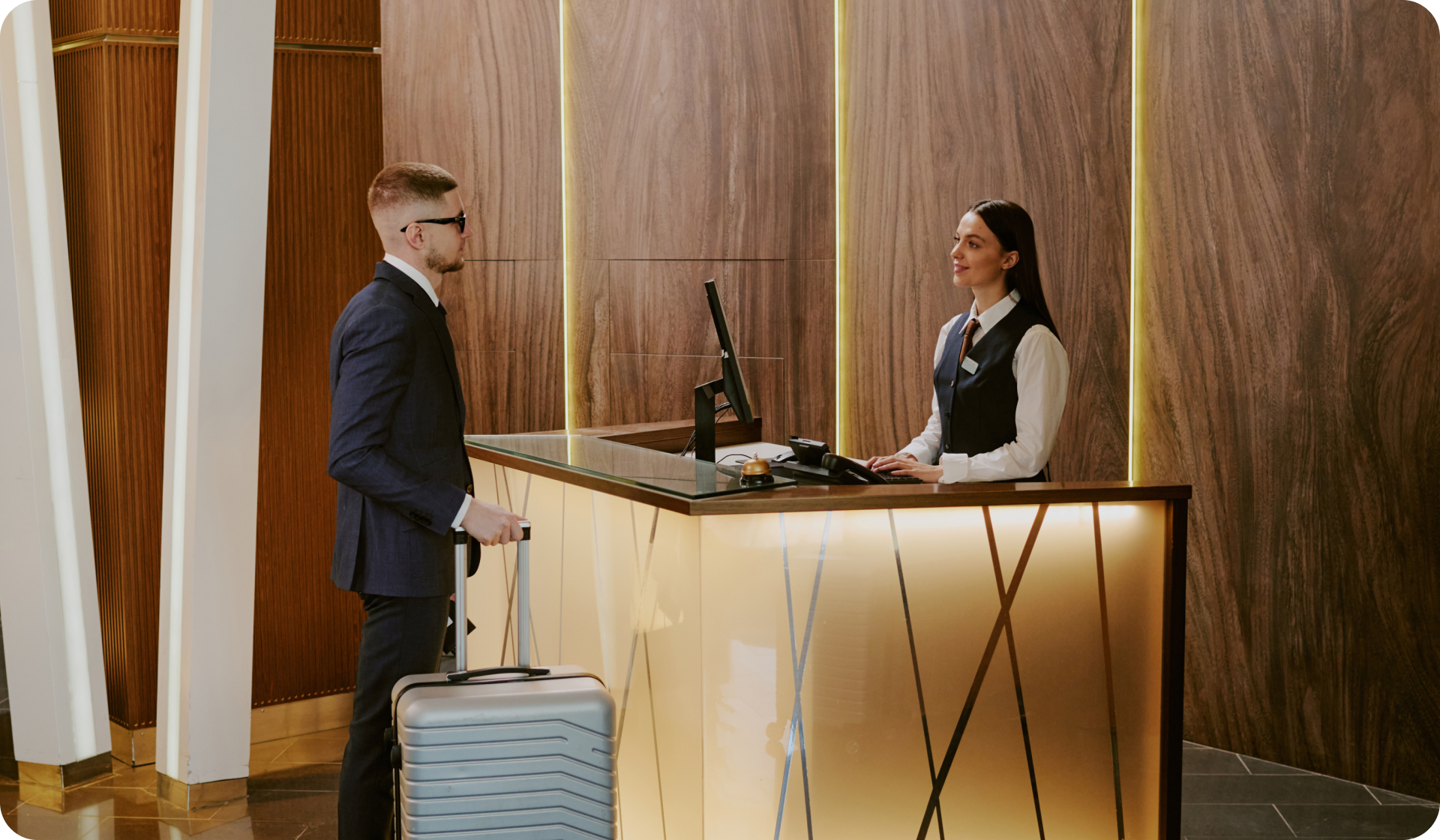
Digital check-in, mobile keys, self-service options, late checkout and flexible cancellation rules all reduce stress and save time. They also help travel managers handle changes without turning every adjustment into a manual exception.
4. Enough power outlets and charging points
Business travellers usually carry multiple devices: laptop, smartphone, headphones, tablet, power bank, smartwatch and sometimes additional work equipment. If the room has only one accessible outlet, the traveller has to choose between charging a laptop and keeping a phone ready for the next day.
Power access should be available where work and rest happen: near the desk, beside the bed, in meeting rooms and in public work areas. USB ports and international plug compatibility are also useful, especially for cross-border trips.
5. Meeting rooms and business services
Not every business traveller needs a full conference facility. But when they do, the hotel should be ready.
Meeting rooms are useful for client presentations, team workshops, interviews, private calls and last-minute preparation sessions. Even a small business centre can be valuable if a traveller needs to print, scan, sign or send documents.
The best business hotels make these services easy to access and simple to book. Travellers should not have to spend valuable time negotiating room availability or searching for basic office support in an unfamiliar city.
6. Dining options that fit business schedules
Business travellers don’t always eat at normal times. They may arrive late, leave early, skip lunch because of meetings or need a quick breakfast before an airport transfer.
A hotel with reliable dining options can make the trip much easier. This does not necessarily mean fine dining. In many cases, practical choices matter more: early breakfast, healthy grab-and-go options, late-night room service, allergy-friendly meals and a restaurant suitable for informal business conversations.
Healthy food options are also a part of traveller wellbeing. Frequent travel can disrupt routines, and a hotel that offers balanced meals helps employees maintain energy throughout the trip.
7. Laundry, ironing and grooming support
For short trips, travellers may only need an iron and ironing board. For longer or multi-city trips, laundry and dry cleaning become much more important.
Business travellers often need to look professional immediately after flights or before important meetings. A hotel that offers quick laundry turnaround, pressing services, shoe cleaning or in-room ironing equipment helps avoid unnecessary stress.
These amenities also allow employees to pack lighter, which is useful for trips with multiple destinations or tight transfer windows.
8. Fitness, wellness and quiet recovery spaces
Productivity is not only about work tools. It also depends on rest, movement and recovery.
A fitness centre, pool, spa, running route, yoga class or quiet lounge can help travellers decompress after long flights and packed schedules. Maintaining routines on the road is not a luxury — it is part of staying healthy and effective.

However, it is important to verify quality. A hotel may list a “fitness centre” even if it only has one outdated treadmill. Travel managers and travellers should look for recent photos and reviews that describe the actual facility.
9. Safety, security and duty of care
Safety is a core part of corporate travel management. This is especially important for solo travellers, employees arriving late at night, first-time visitors and trips to unfamiliar destinations.
A business-friendly hotel should support duty of care through secure access, well-lit entrances, safe transport options, reliable reception and clear emergency support. Security should not feel complicated, but it should be visible enough to give travellers confidence.
For travel managers, hotel safety is not just about the property. It is also about knowing where employees are staying, being able to assist quickly if plans change and having a system that keeps travel information accessible.
10. Sustainability as a business travel factor
Sustainability has moved from a nice-to-have to a real decision criterion in corporate travel. Companies increasingly report on travel emissions, set reduction targets and answer to procurement, investors or regulators on how they travel — and in some markets, such as the DACH region, that scrutiny is now the norm rather than the exception. For travel managers, this means hotel choice is no longer only about location, comfort and cost. It's also about whether a stay fits the company's environmental commitments.
The practical challenge is separating genuine practice from marketing. A property may advertise itself as "green" while doing little beyond reusing towels. Recognised certifications — such as Green Key, LEED or EU Ecolabel — and measurable data are more reliable signals than claims on a booking page. What matters most is whether emissions and responsible practices are visible enough to factor into the decision, and whether that information can flow into company reporting rather than being reconstructed by hand later.
Sustainability rarely competes with the other priorities in this guide — it usually reinforces them. Well-run, efficient hotels tend to be the ones with reliable systems, better-maintained rooms and consistent service. Choosing them supports company goals and the traveller's experience at the same time.
Practical hotel checklist for travel managers
When comparing hotels for business trips, a simple checklist can prevent poor booking decisions. Instead of asking only “Is this within budget?”, travel managers should also ask whether the hotel supports the traveller’s actual workday.
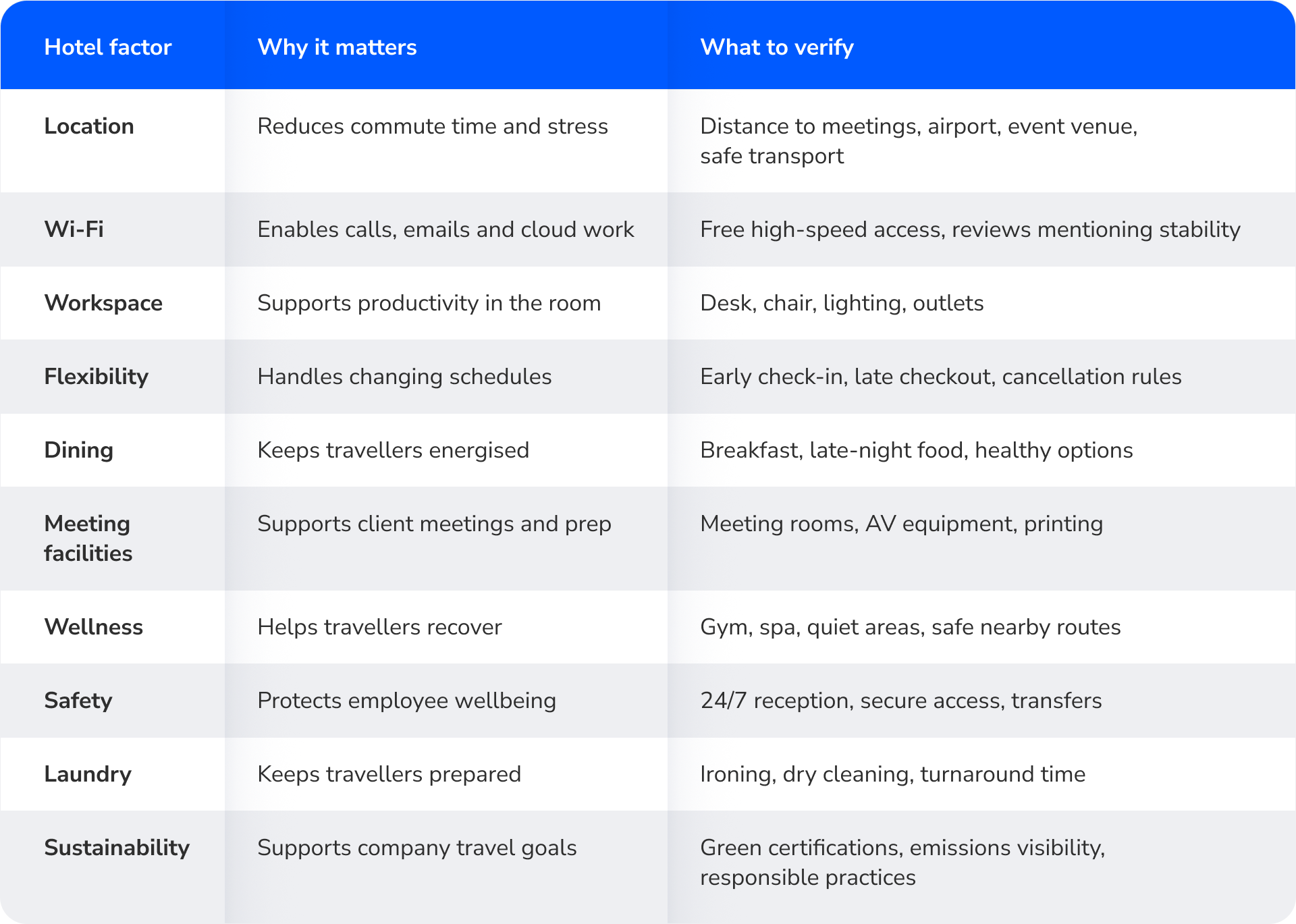
This checklist can be adapted by trip type. A one-night sales trip may prioritise location and late checkout. A week-long project may require laundry, a larger room and healthy dining. A leadership trip may require meeting rooms, airport transfers and concierge support.
Choosing the right type of business accommodation
The best accommodation type depends on the trip purpose, budget, length, traveller profile and company policy.
-
City-centre hotels. Best for client meetings, conferences and trips where travellers need quick access to multiple locations. They are often more expensive, but may reduce transport costs and lost time.
-
Airport hotels. Best for early departures, late arrivals, short stays and transit-heavy itineraries. They are practical when the traveller doesn’t need to spend much time in the city.
-
Extended-stay hotels. Best for projects lasting a week or longer. These properties often include larger rooms, kitchen facilities, laundry options and more comfortable living space.
-
Aparthotels and serviced apartments. Best for long stays, relocation projects or travellers who need more privacy and independence. They can also help reduce dining costs because employees can prepare simple meals.
-
Chain hotels. Best for consistency, loyalty benefits, predictable standards and global travel programs. They are often easier to include in company travel policies.
-
Boutique hotels. Best for travellers who value design, local atmosphere and client-friendly meeting environments. They can work well for executive trips or creative industries, provided they meet business basics such as Wi-Fi, workspace and service reliability.
How to avoid overpaying for business hotels
A good corporate accommodation strategy should balance traveller comfort with budget control. The goal is not to book the cheapest available room. The goal is to avoid unnecessary spend while still choosing hotels that support productive trips.
Here are several ways to do that:
1. Define hotel rules by trip purpose
A single hotel budget may not work for every trip. A senior executive attending investor meetings may need a different hotel category than an employee visiting a supplier for one night. A long-stay project may require different amenities than a short conference trip.
Clear travel policy rules help employees make better choices without needing approval for every detail.
2. Use preferred hotels in repeat destinations
If employees regularly travel to the same cities, create a shortlist of verified hotels. Track which properties consistently perform well on location, Wi-Fi, workspace, service and total cost.
This reduces decision fatigue and improves booking consistency.
3. Look at total trip cost, not only room rate
A cheaper hotel may become more expensive when it requires longer commutes, extra taxis, paid Wi-Fi, breakfast outside the property or additional workspace rental.
The true cost of accommodation includes time, transport, productivity and traveller wellbeing.
4. Capture feedback after each stay
Travellers often notice details that booking platforms miss. Was the room quiet? Did the Wi-Fi support video calls? Was the gym actually usable? Was the area safe at night?
Collecting this feedback helps improve future hotel choices and prevents repeated mistakes.
5. Centralise booking and reporting
When accommodation is booked across multiple channels, companies lose visibility. Travel managers cannot easily track spend, enforce policy, support employees or identify better supplier options.
Centralised booking gives companies more control and gives travellers a smoother experience.
How Tumodo helps companies book better business hotels
Choosing the right hotel for a business trip should not require hours of manual comparison. Travel managers need visibility and control. Employees need speed and flexibility. Finance teams need clean documentation and predictable costs.
Tumodo brings business travel services into one platform, helping companies manage flights, accommodation, transfers, approvals, reporting and support in a more connected way.
For hotel bookings, this matters because the right platform helps companies:
-
compare accommodation options faster;
-
keep bookings aligned with travel policy;
-
reduce out-of-policy spend;
-
give employees more autonomy within approved limits;
-
access travel information in one place;
-
simplify reporting and documentation;
-
support travellers when plans change;
-
improve the overall business travel experience.
A strong hotel choice is not only about amenities. It’s about creating a travel process where employees can focus on work instead of logistics.
Business travellers don’t need hotels to be extravagant. They need them to be practical, reliable, safe and aligned with the purpose of the trip.
The most valuable hotel amenities are the ones that protect time and energy: a convenient location, fast Wi-Fi, a real workspace, flexible check-in, healthy food, reliable service, good sleep and support when something changes.
For companies, the challenge is to make those choices consistently — across teams, destinations, budgets and changing schedules. With the right travel policy, clear hotel criteria and a centralised platform like Tumodo, accommodation booking becomes less reactive and more strategic.
A good hotel does more than host a traveller overnight. It helps the business trip succeed.
FAQ
What are the most important hotel amenities for business travellers?
The most important amenities are reliable Wi-Fi, a convenient location, a comfortable workspace, enough power outlets, flexible check-in and checkout, safe transport options, dining availability, laundry support, meeting facilities and quiet rooms for rest.
How should travel managers choose hotels for employees?
Travel managers should evaluate hotels based on the purpose of the trip, location, total cost, safety, traveller preferences, company policy and amenities that directly affect productivity. The cheapest option is not always the most cost-effective one.
Why is location so important for business hotels?
Location affects commute time, punctuality, transport costs, traveller stress and the overall efficiency of the trip. A well-located hotel can save hours across a multi-day itinerary.
Are serviced apartments good for business travel?
Serviced apartments and aparthotels can be a strong option for longer stays. They usually offer more space, kitchen facilities, laundry options and a home-like environment, which can improve comfort and reduce costs on extended trips.
How can companies control hotel costs without hurting traveller experience?
Companies can control hotel costs by setting clear travel policies, using preferred hotels, considering total trip cost, centralising booking, tracking traveller feedback and using a platform that provides visibility across spend, approvals and reporting.