A reimbursable expense is a legitimate business cost that an employee pays personally and later claims back from their employer. Typical examples include local transport, accommodation, business meals, visa fees and other necessary costs incurred while carrying out work duties.
Payment alone doesn’t make an expense reimbursable. The cost must normally have a clear business purpose, comply with company policy, remain within any applicable limits and be supported by the required documentation.
This guide focuses on employee business expense reimbursement. It explains which employee-paid costs commonly qualify, which purchases are usually excluded and how organisations can protect employees without losing control of travel spending.
What’s inside
- When is an expense reimbursable?
- Why reimbursement matters to employees and finance teams
- Reimbursement vs corporate cards, advances and per diems
- Common reimbursable expense examples
- Reimbursable, non-reimbursable and conditional expenses
- What documents are required?
- How the expense reimbursement process works
- International reimbursements: currencies, exchange rates and documents
- Are reimbursed expenses taxable?
- What an effective reimbursement policy should cover
- How Tumodo supports controlled business travel
- FAQ
When is an expense reimbursable?
An expense is generally reimbursable when an employee temporarily covers a company cost because an approved company payment method is unavailable or impractical.
For example, an employee travelling to meet a client may pay for a taxi from the airport using a personal card. The employee keeps the receipt, records the destination and business purpose, then submits the cost through the company’s expense reimbursement process.
Most organisations assess a claim against five conditions:
- Legitimate business purpose. The purchase must be necessary for completing work, attending a business event or supporting a company activity.
- Policy compliance. The expense category, amount, supplier and purchase method must follow the organisation’s rules.
- Reasonableness. The cost should be appropriate for the destination, purpose and circumstances.
- Sufficient evidence. The employee should provide the required receipt, invoice, proof of payment or other accepted record.
- Timely submission. The claim should be filed within the company’s stated deadline.
Meeting one condition does not guarantee approval. A hotel stay may have a valid business purpose but still exceed the permitted nightly rate. Without prior approval, the company may reimburse only the policy limit or reject the excess amount.
Why reimbursement matters to employees and finance teams
- Reimbursement affects employee cash flow, travel policy compliance, accounting accuracy and the company’s visibility into total travel spend.
- Employees avoid carrying company costs for longer than necessary, particularly after international travel or high-value bookings.
- Finance teams can categorise spending by employee, trip, department, project, cost centre or destination.
- Approvers can apply consistent rules and identify recurring exceptions or unusually high costs.
- Complete records reduce reconciliation work and improve budgeting and financial reporting.
- Clear rules strengthen employee confidence because similar claims receive similar decisions.
Reimbursement vs corporate cards, advances and per diems
Not every business expense is a reimbursable expense. The difference depends on who initially paid for the purchase and how the company records it.
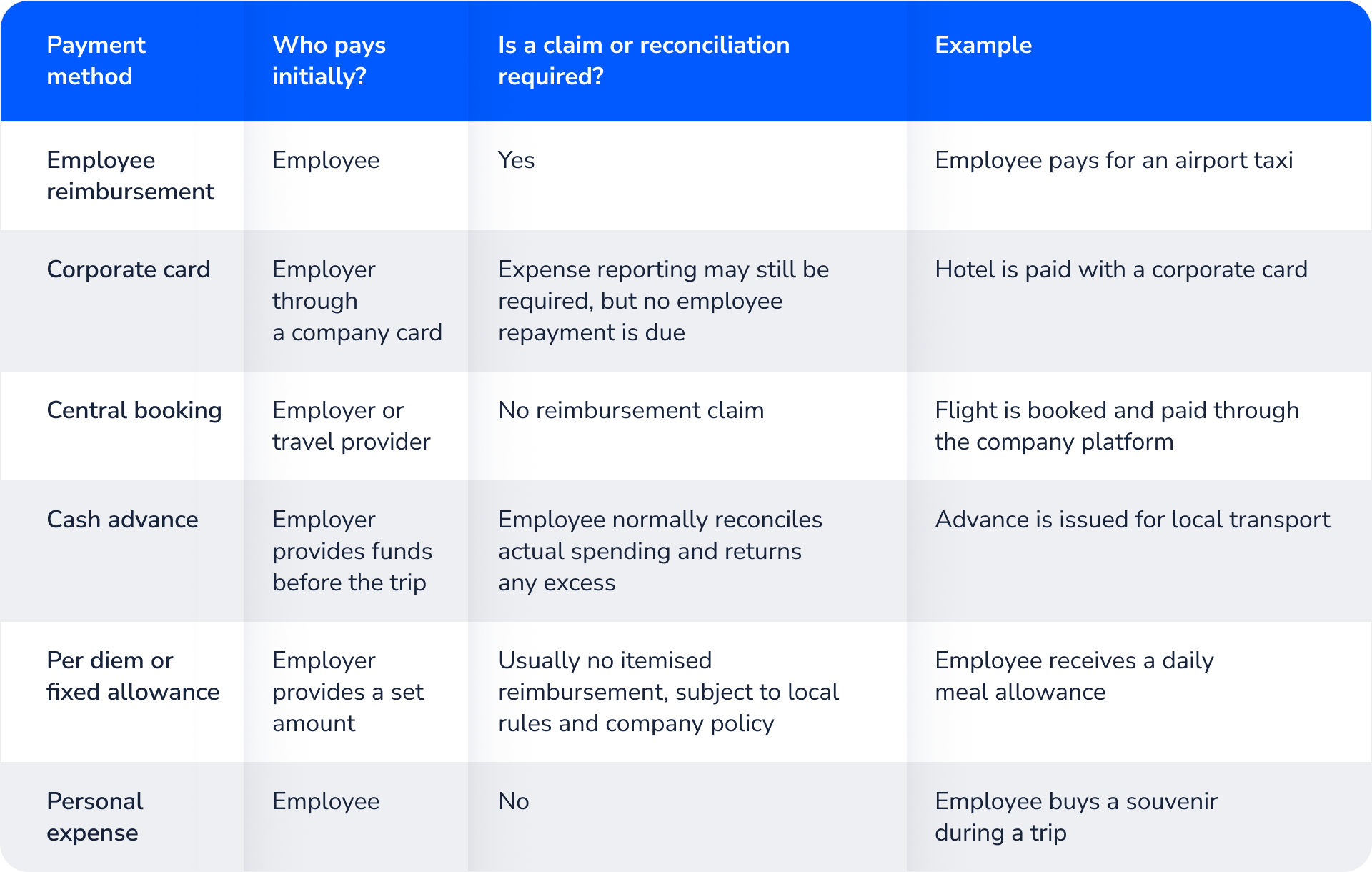
Corporate card purchases still need to be documented and categorised. Keeping them separate from employee-paid claims prevents duplicate payments and makes reconciliation easier.
Common reimbursable expense examples
The exact categories depend on the employer’s expense reimbursement policy. The following business travel expenses are commonly eligible when they are necessary, reasonable and properly documented.
Transportation
Transportation expenses may include:
- air or rail tickets purchased personally for an approved trip;
- taxis, ride-hailing services and airport transfers;
- public transport used to reach meetings or business events;
- car hire;
- parking charges;
- business mileage when an employee uses a personal vehicle.
Flights and long-distance rail tickets are often booked centrally. They become reimbursable when an employee must make an urgent or approved purchase personally.
Accommodation
Reimbursable accommodation expenses may include:
- hotel rooms or serviced apartments;
- mandatory hotel taxes and service charges;
- business internet access;
- approved early check-in or late check-out fees.
Optional services such as spa treatments, personal minibar purchases and in-room entertainment are normally excluded.
Meals and client entertainment
Meals may qualify during an approved business trip, client meeting or company event. An organisation may reimburse actual costs based on receipts or provide a fixed allowance.
Limits may vary by destination, trip duration or meal type.
Client entertainment usually requires additional information, such as attendee names, the business purpose and prior approval. Because it can create financial and reputational risk, many companies apply stricter review rules.
Communication expenses
Employees travelling internationally may incur additional communication costs, such as:
- work-related mobile data, international roaming and business calls;
- hotel or in-flight Wi-Fi required for work;
- business visa fees and consular charges;
- required document processing, photographs or delivery fees;
- passport-related costs where explicitly permitted by company policy.
Professional events and operational purchases
- Approved conference, exhibition or training registration
- Local transport and materials required to attend the event
- Printing, adapters, basic office supplies or other small items needed to complete work
- Urgent purchases that cannot reasonably be arranged through the usual procurement process
Reimbursable, non-reimbursable and conditional expenses
Business necessity and company policy are the main dividing lines. Personal purchases, duplicate claims and costs with no clear connection to work are generally non-reimbursable.
Common exclusions include:
- leisure activities and personal entertainment;
- souvenirs and clothing for general personal use;
- traffic or parking fines;
- personal grooming;
- unapproved premium travel upgrades;
- travel costs for partners or family members;
- additional hotel nights added for personal reasons;
- purchases already paid with a corporate card;
- expenses with no clear business purpose or sufficient evidence.
Some costs are conditional rather than automatically allowed or prohibited. The policy should explain these grey areas instead of leaving employees to guess.
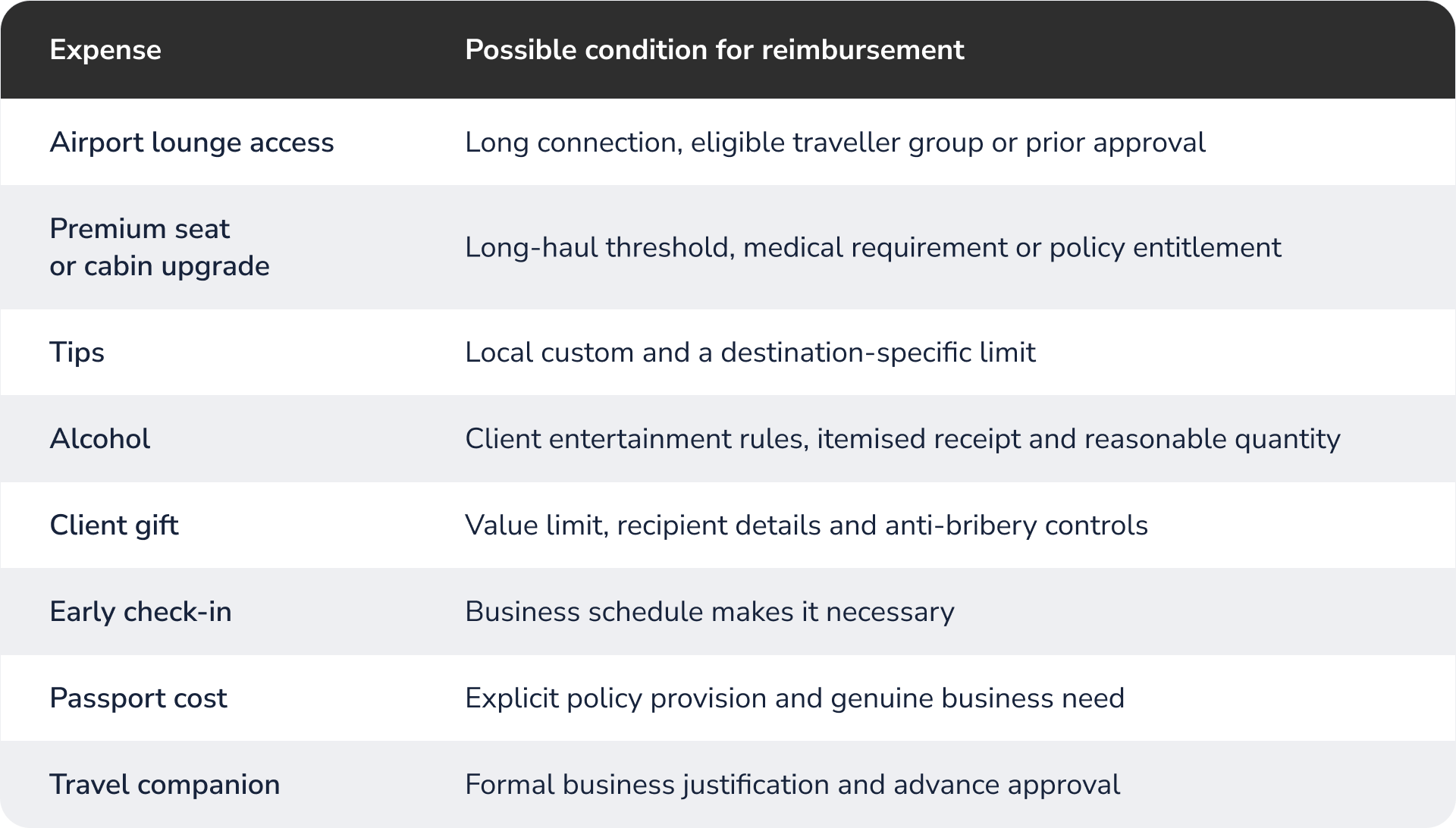
Practical reimbursement examples
Hotel above the policy limit
An employee books a hotel for $220 per night when the destination limit is $180. The trip is legitimate, but the additional $40 may require prior approval. Without it, the company may reimburse only $180.
Mixed business and personal trip
An employee extends a three-day business trip by two personal nights. The company may reimburse the business accommodation and the return journey up to the cost of the approved itinerary. The additional nights and any extra fare caused by the extension remain personal.
Client entertainment dinner
A client dinner may be reimbursed when the employee records the attendees, business purpose and itemised bill. Costs for personal guests or unrelated entertainment would normally be excluded.
What documents are required?
A complete claim normally needs both transaction evidence and a business justification. These serve different purposes.
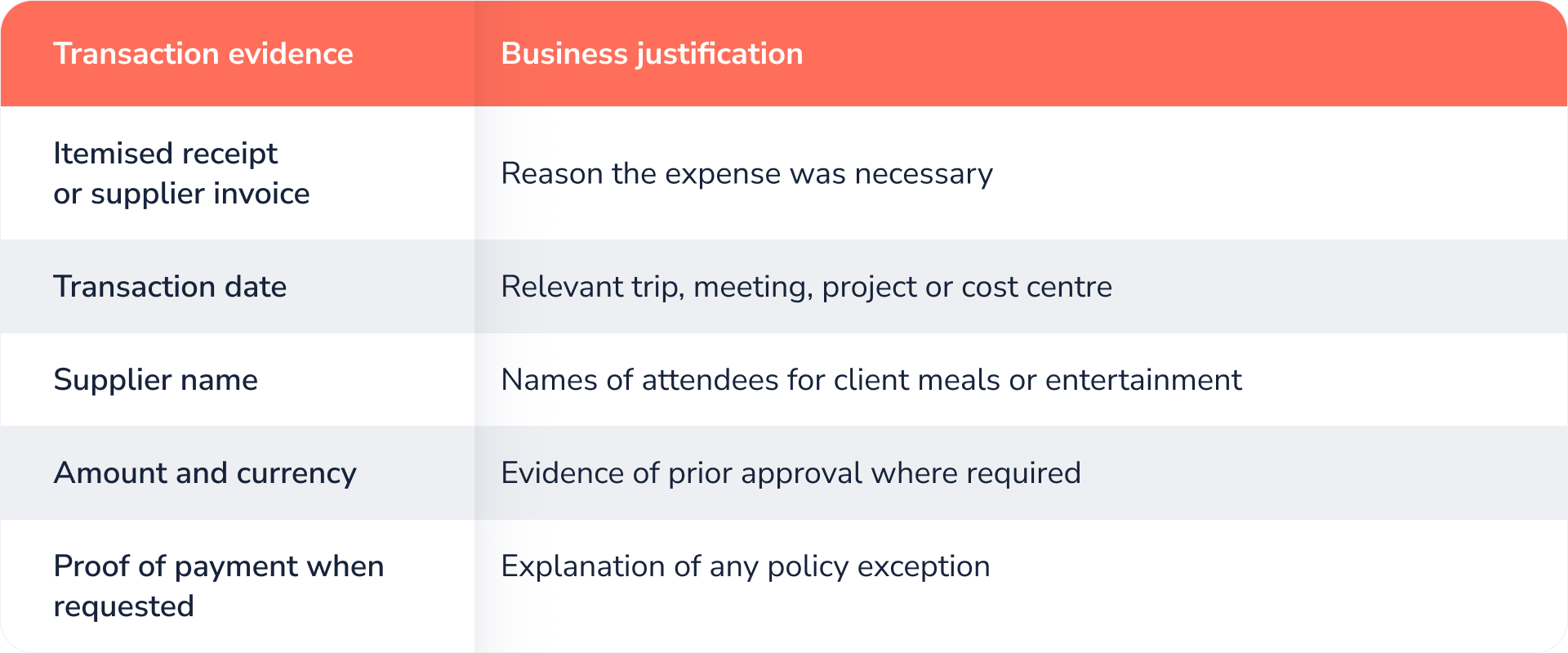
A bank or card notification may prove that payment occurred, but an itemised receipt or invoice is usually needed to show what was purchased and whether every item was business-related.
Employees should capture digital copies as soon as possible. Paper receipts can fade or become lost during a trip. The policy should also explain what happens when a supplier cannot issue a receipt or the original document is missing.
How the expense reimbursement process works
- Check the policy. The employee confirms whether the expense is allowed, whether a limit applies and whether advance approval is required.
- Obtain approval when necessary. High-value bookings, premium services, client entertainment and policy exceptions may need approval before purchase.
- Make the purchase. When central payment or a corporate card is unavailable, the employee uses personal funds and retains the required documents.
- Record the expense. The employee enters the amount, currency, category, trip and business purpose in the expense report.
- Attach supporting evidence. Receipts, invoices, proof of payment and approval records are added to the claim.
- Review the claim. A manager, travel coordinator or finance specialist checks the expense against the policy and may approve, reject or request more information.
- Reimburse and record. The approved amount is repaid through the company’s chosen process and recorded in its financial system.
Clear deadlines, automatic routing and complete documentation reduce follow-up questions and shorten the time between submission and payment.
International reimbursements: currencies, exchange rates and documents
International claims add multiple currencies, card conversion fees, different invoice formats and country-specific tax documentation. A global policy needs enough consistency to control spending while allowing for local requirements.
The policy should state:
- whether employees enter the original currency, the converted amount or both;
- which exchange rate is used and which date determines it;
- whether foreign transaction and card conversion fees are reimbursable;
- how cash expenses are evidenced;
- which local tax invoices or supplier details are required;
- how regional hotel, meal and transport limits are set;
- who approves cross-border claims and exceptions;
- when the employee can expect repayment.
For example, a company may reimburse the settled amount shown on the employee’s card statement. Another organisation may apply an official rate used by its accounting system on the transaction date. The policy should identify one method and apply it consistently.
Are reimbursed expenses taxable?
Reimbursement does not automatically determine the tax treatment of an expense. The outcome can depend on the country, the business purpose, the evidence provided, the timing of the claim and the way the employer’s reimbursement arrangement is structured.
A payment that matches a documented business cost may be treated differently from a fixed allowance or an amount that exceeds the employee’s actual expense. A cost may also be permitted under company policy but require different tax or accounting treatment.
Organisations should therefore align reimbursement rules with local payroll, tax and record-keeping requirements and obtain qualified advice where necessary.
What an effective reimbursement policy should cover
- Eligible categories. List the costs normally reimbursed and provide practical examples for transport, hotels, meals, communication and other relevant areas.
- Exclusions and grey areas. Explain which purchases are personal and which conditional costs require prior approval.
- Destination-based limits. Use realistic hotel, meal and transport limits that reflect local prices rather than one global cap.
- Approval rules. State which expenses require pre-approval and who can authorise them.
- Documentation standards. Define acceptable receipts, invoices, proof of payment and the process for missing documents.
- Submission and payment timelines. Specify when employees must submit claims and when approved amounts will be paid.
- Currency conversion. Use a consistent method for foreign-currency expenses and card fees.
- Exception process. Provide a clear contact and decision path for urgent or unavoidable out-of-policy spending.
- Consistent review. Ensure approvers use the same rules and record the reason for valid exceptions.
Common reimbursement mistakes
- Mixing personal and business items without clearly identifying the amount claimed.
- Using descriptions such as “transport” or “meeting” instead of explaining the route or business purpose.
- Selecting the wrong category, trip, project or cost centre.
- Requesting reimbursement for a corporate card transaction.
- Waiting until receipts are lost or the reporting period has closed.
- Making an out-of-policy booking without approval.
- Approving similar expenses differently without documenting the reason.
A stronger description would be “Taxi from Dubai International Airport to client meeting” rather than simply “transport”. Specific information allows the approver to assess the claim without requesting clarification.
How companies can reduce employee out-of-pocket spending
Employee-paid travel costs are often a symptom of fragmented travel management. The traveller books outside the approved channel, policy is checked only after purchase, finance learns about the cost when the claim arrives and the employee carries the expense in the meantime.
Centralised business travel management changes the sequence. Policy can be applied before confirmation, approval can be recorded before money is committed and the company or an approved payment method can pay the main travel costs directly.
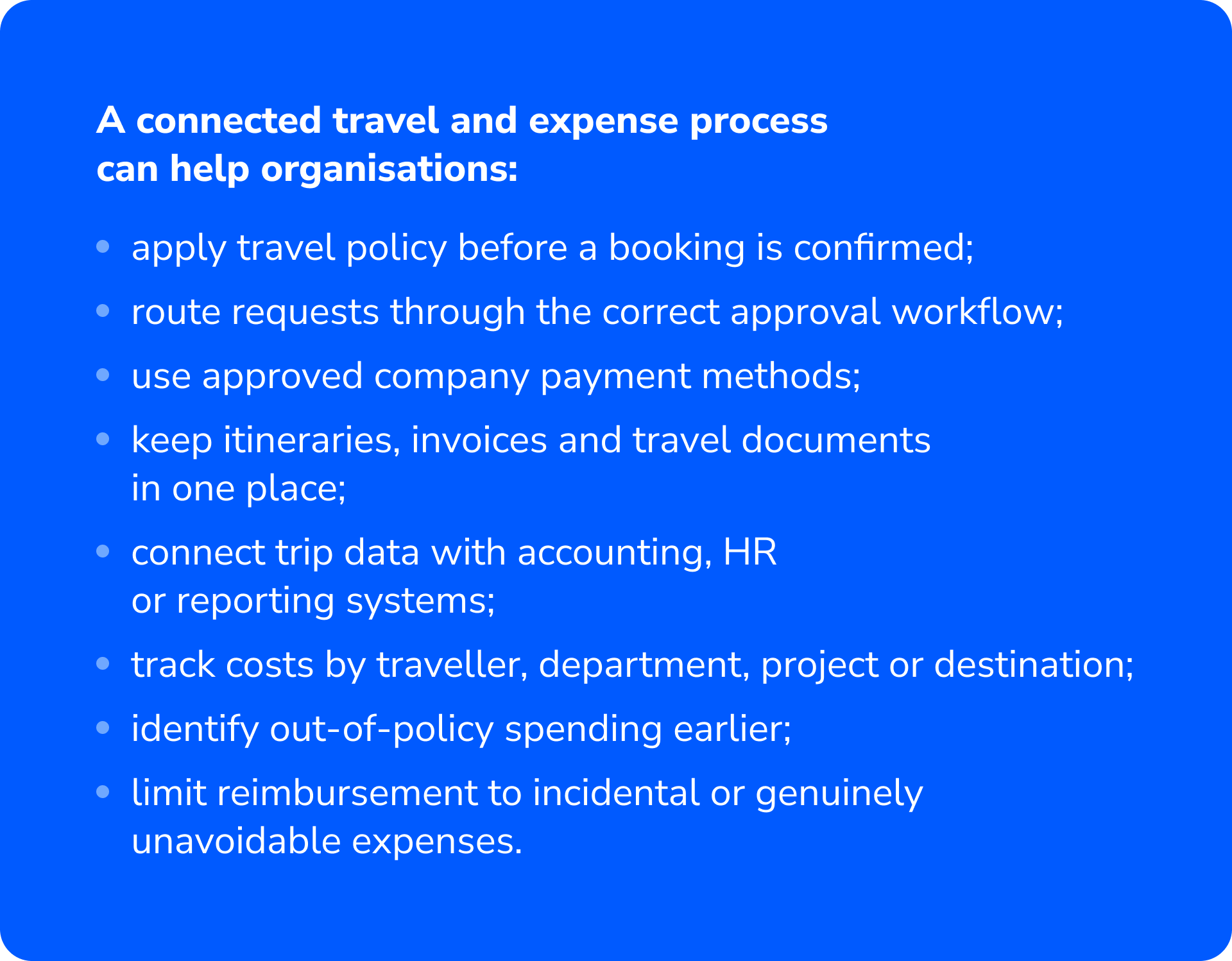
The best reimbursement process is not simply a faster way to repay employees. It’s a system that reduces how often they need to use personal money in the first place.
How Tumodo supports controlled business travel
Tumodo brings flights, accommodation, rail and car transfers into one corporate travel platform, helping companies manage policy, approvals, documentation and reporting before reimbursement becomes necessary.
Before the trip
- Centralised booking for approved travel services
- Configurable travel policies and spending limits
- Approval workflows before bookings are confirmed
- Fewer fragmented purchases made with personal funds
During the trip
- Online access to booking details and travel documents
- 24/7 support before, during and after travel
- Help with urgent changes, reducing the need for unapproved alternatives
After the trip
- Structured travel data for finance and operations teams
- Integration opportunities with accounting or HR systems
- Real-time reporting by traveller, department, trip or project
- Clearer visibility into committed and completed travel spend
This gives travellers fewer expenses to fund personally and gives finance teams earlier visibility into costs. See how Tumodo can centralise business travel bookings, approvals and reporting while reducing employee out-of-pocket spending.
FAQ
What is a reimbursable expense?
A reimbursable expense is a legitimate business cost paid personally by an employee and later repaid by the employer. It normally needs to comply with company policy and be supported by the required evidence.
What are common reimbursable expense examples?
Typical examples include taxis, hotels, business meals, parking, tolls, business mileage, visa fees, conference registration and work-related internet access.
What is the difference between reimbursement and a per diem?
Reimbursement repays an employee for an actual eligible cost, usually after a claim is reviewed. A per diem is a fixed daily amount intended to cover defined travel expenses, subject to company policy and local rules.
Are reimbursed expenses taxable?
Not necessarily. Tax treatment depends on the jurisdiction, the business purpose, the documentation and the structure of the employer’s reimbursement arrangement. Companies should follow local payroll and tax requirements.
Can an employee be reimbursed without a receipt?
This depends on company policy and local record-keeping requirements. Some organisations accept alternative proof or a missing-document declaration in exceptional cases, while others require a receipt for every claim.
Can a company reject a legitimate business expense?
Yes. A cost may have a valid business purpose but still breach a spending limit, approval rule, booking requirement or submission deadline. A clear policy should explain how exceptions are handled.
Are commuting costs reimbursable?
Ordinary travel between home and a regular workplace is often treated differently from business travel, but the answer depends on local law and company policy. Travel to a temporary workplace or client site may be treated differently.
Are business meals and alcohol reimbursable?
Business meals are commonly reimbursable within policy limits. Alcohol may be restricted or allowed only for approved client entertainment, with an itemised receipt and clear business purpose.
How are foreign-currency expenses converted?
The company should define the exchange-rate source and relevant date. It may use the settled card amount, an accounting-system rate or another consistent method.
How quickly should employees be reimbursed?
The timeline depends on the organisation’s process. Companies should publish a clear service standard and repay approved claims promptly so employees are not required to finance business operations for longer than necessary.