 Andrew BaturinCMO at Tumodo
Employees dislike business travel not because they dislike travelling itself, but because of poor processes, rigid travel policy and lack of control. The paradox of business travel is that it promises growth and career opportunities, yet often creates stress and burnout.
How companies can improve the employee travel experience by introducing flexibility, automation, transparency and proper support systems. When business travel is built around people rather than cost control alone, employee motivation and loyalty increase naturally.
Key article insights
-
The paradox of business travel lies in its dual nature: career opportunity versus personal cost
-
A rigid travel policy can reduce employee motivation for business trips
-
Business travel challenges directly affect employee engagement and retention
-
Why employees quit due to bad travel policy is often linked to burnout and lack of autonomy
-
Business traveller satisfaction grows when processes are simple, transparent and flexible
The hidden friction behind corporate travel
Employees dislike business travel when it feels like an obligation without proper support or flexibility. The issue is rarely the trip itself — the real problem lies in the system behind it.
Many companies still treat travel as a perk. In reality, it often means early flights, back-to-back meetings, time away from family and administrative burden. When booking tools are fragmented, approval processes are slow, a rigid travel policy is difficult to navigate and routine tasks take too long, even a short trip becomes exhausting before it starts.
This is where business travel challenges begin to affect corporate travel employee engagement.
The paradox of business travel
At its core, this paradox is simple: business travel can accelerate career advancement, yet simultaneously reduce wellbeing and motivation.
On paper, the benefits of business travel for employees are clear:
-
exposure to leadership,
-
networking opportunities,
-
international experience,
-
faster career progression.
In practice, employees often experience something different.
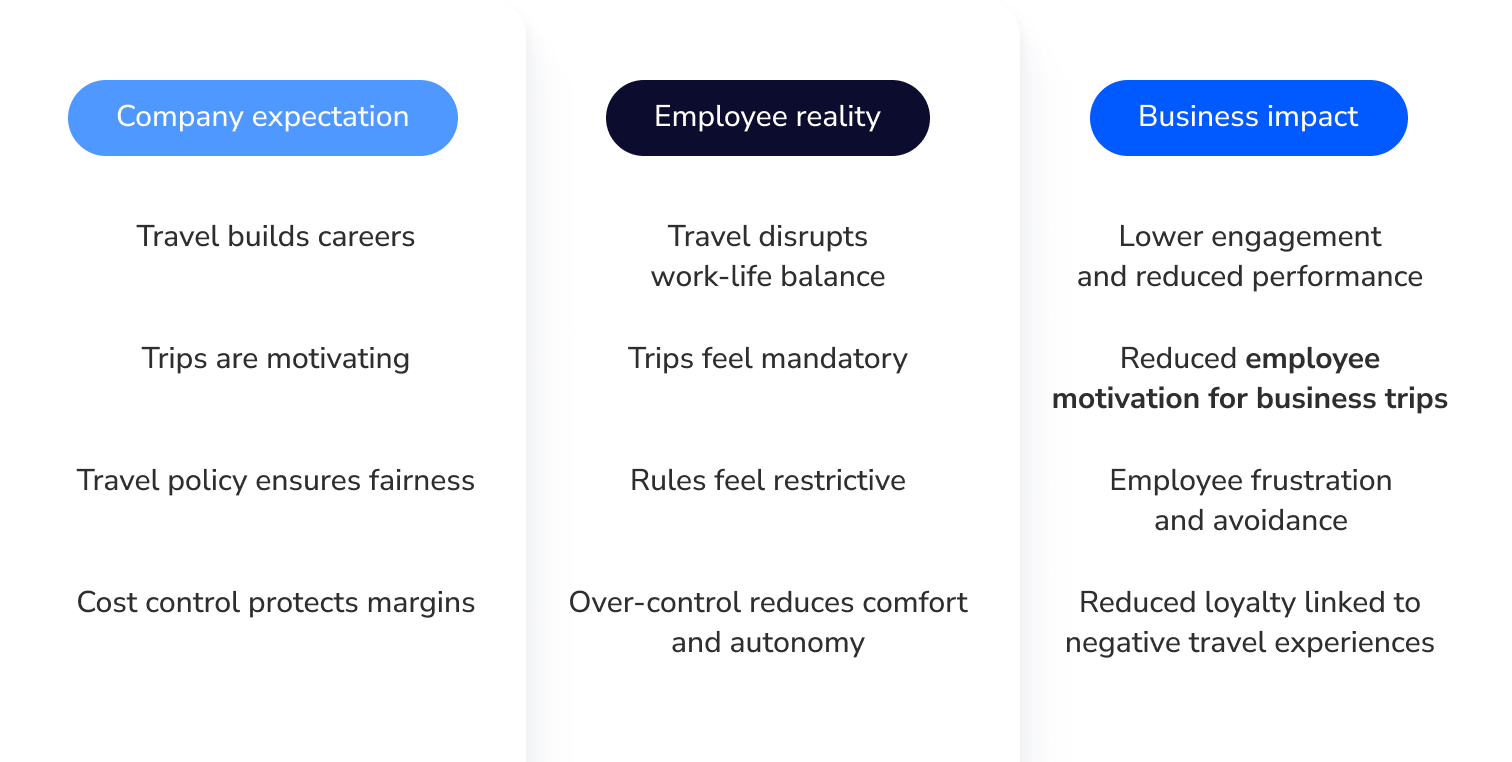
When companies ignore this gap, the dark side of business travel becomes visible.
Why employees might hate business trips
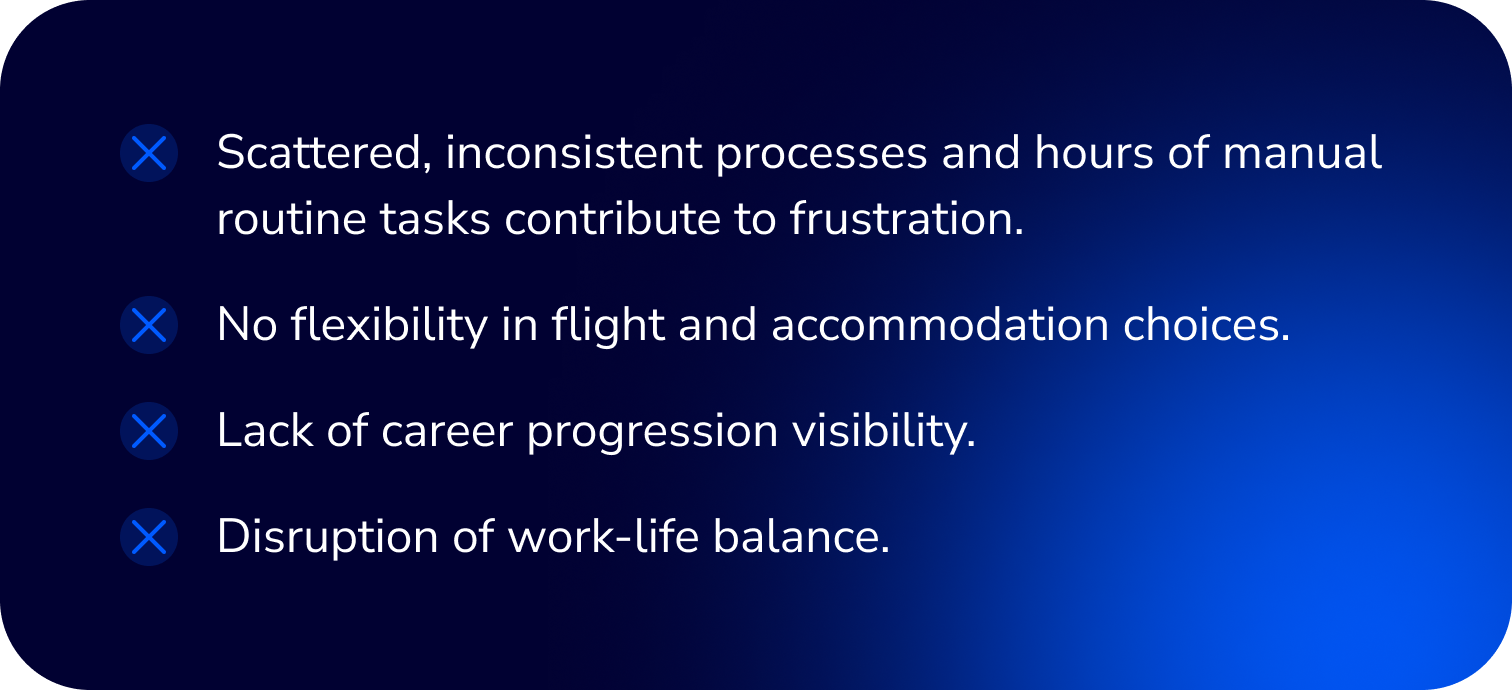
Employees hate business trips when the process is poorly managed and adds friction. The friction usually starts long before departure.
The most common challenges of business travel for employees include the following issues.
-
Disconnected tools and processes: booking through offline agencies, approvals via email and expenses in spreadsheets create unnecessary stress.
-
Rigid travel policy rules with no flexibility, limiting comfort and quality choices.
-
Complicated approval workflows that slow the process down for days.
-
Overwhelming routine tasks and no automation.
-
Lack of real-time human support during disruptions.
-
Personal cost: missed family time, sleep disruption, health impact.
These business travel challenges often accumulate over time. When employees feel that travel is imposed rather than designed for them, resistance grows.
When business travel leads to burnout or resignation
Business travel leads to burnout when it is poorly managed, too frequent and lacks proper compensation or recovery time. Over time, this directly affects retention.
Resignation rarely happens because of a single trip. It happens when friction becomes the norm.
Common mistakes companies make
-
Treating travel as a privilege rather than workload
-
Designing travel policy only around cost reduction
-
Ignoring employee feedback
-
Failing to measure business travel quality
-
Fragmented corporate trip management processes
-
Inadequate compensation for travel time
When corporate trips feel unfair or exhausting, employee loyalty towards business travel declines. In competitive markets, this matters.
What drives business travel employee satisfaction
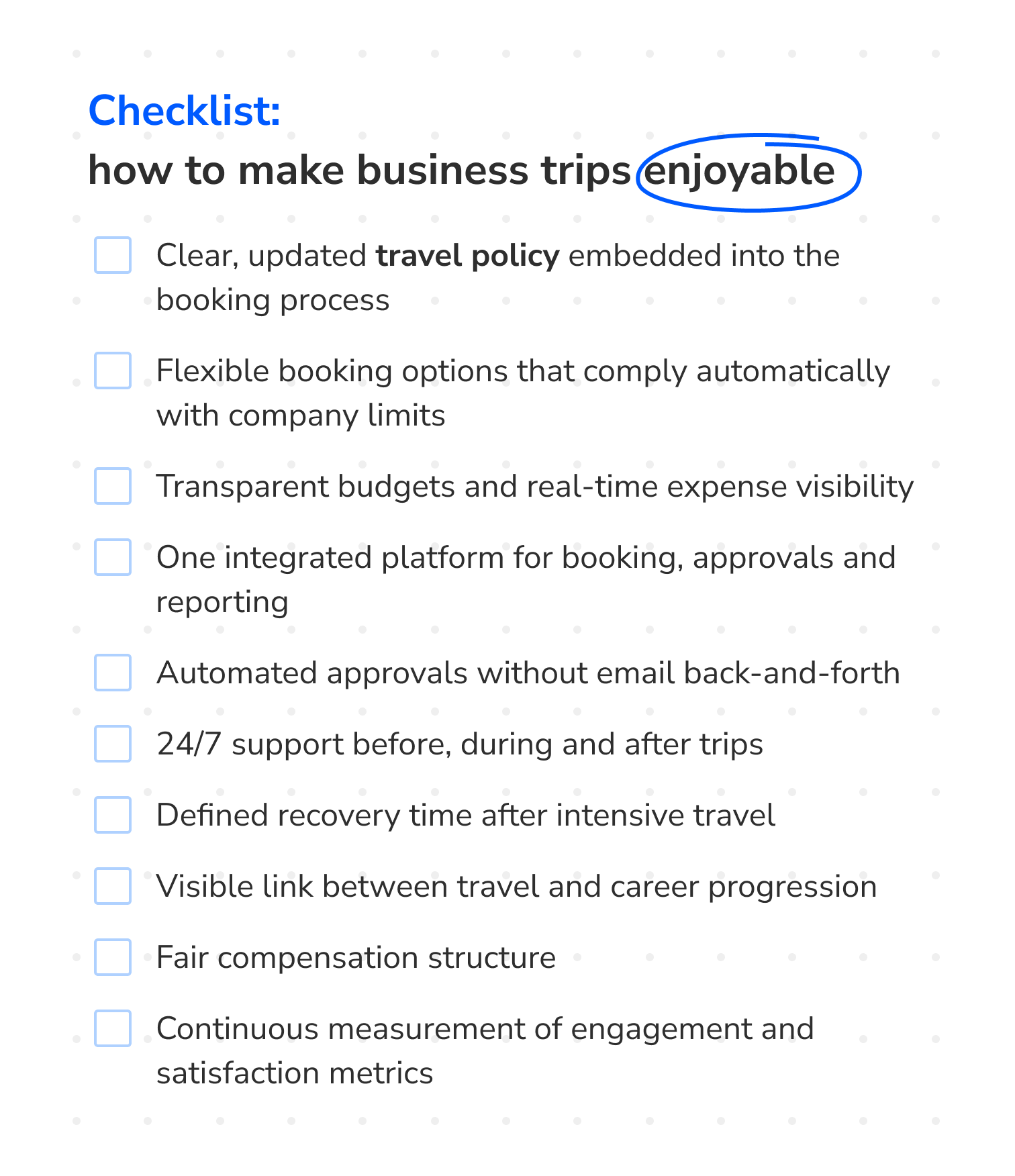
Business travel employee satisfaction depends on comfort, clarity, support and appropriate compensation.
This is what increases motivation for business trips.
-
A simple, optimised process around business travel:
- booking options respect personal preferences within travel policy limits,
- approval timelines are predictable,
- manual work is reduced thanks to automation,
- real-time human support is available 24/7.
-
Travel clearly connects to career development
-
Fair compensation
Corporate travel employee engagement improves when employees feel trusted rather than controlled. Technology plays a key role here: integrated booking flows, embedded travel policy and automated expense reporting reduce friction dramatically.
When the system works quietly in the background, employees focus on meetings, not administration.
How to improve the employee travel experience
To improve the employee travel experience, companies need more than updated guidelines — they need a structured, intelligent platform that removes friction by design. Clarity and flexibility should be built into the system itself, not managed manually.
Step-by-step plan
-
Collect honest employee feedback about travel pain points and quantify where time and energy are lost.
-
Audit your current travel policy, workflows and financial structure to identify manual bottlenecks.
-
Replace fragmented tools with a single digital platform that connects booking, approvals and reporting.
-
Set up embedded travel policy directly into the booking flow so non-compliant options are filtered automatically.
-
Automate approval routing based on role, budget and travel policy rules to eliminate email chains.
-
Automate expense reporting with real-time data synchronisation instead of spreadsheets.
-
Ensure 24/7 human support backed by live system visibility.
-
Track business travel employee satisfaction with measurable indicators.
A smart platform enforces compliance automatically while giving employees flexibility within clear boundaries.
What do to if…
-
If employees avoid trips → review flexibility within the travel policy and ensure booking autonomy inside predefined limits.
-
If burnout increases → monitor trip frequency through system data and build recovery time into planning.
-
If approvals delay trips → introduce automated workflows with predefined approval hierarchies.
-
If expenses cause frustration → centralise reporting in one platform with automatic reconciliation.
-
If motivation drops → connect business travel to visible career development goals and recognition.
When companies move from manual coordination to intelligent automation, they reduce hidden administrative cost and remove unnecessary stress. This is how business travel becomes scalable, sustainable and aligned with both employee wellbeing and business performance.
The final thought
Employees dislike business travel when the system behind it creates stress and removes autonomy. The paradox of business travel is that it can drive growth while simultaneously reducing wellbeing.
The solution is not to reduce travel entirely. It is to redesign how it works. When companies simplify booking, embed travel policy into the flow and support employees before, during and after the trip, business travel employee satisfaction rises. And when the experience improves, so do engagement, motivation and loyalty.
Business travel is not the problem — poor management is.
Sources
- Gallup. State of the Global Workplace: 2023 Report.
- Global Business Travel Association (GBTA). Business Travel Index Outlook 2023.
- Deloitte. 2023 Global Human Capital Trends.
- Tumodo. How Business Travel Shapes Employee Loyalty.
This article is based on HR engagement research, global business travel industry data and practical experience designing and managing corporate travel programmes at Tumodo. Its purpose is to help companies improve the employee travel experience while maintaining engagement, retention and cost control.