How to implement corporate travel management software
A travel management software implementation rarely fails on the software. It fails in the gap between go-live and genuine use — the weeks where travellers decide whether the new platform is easier than what they did before, and finance decides whether it can trust the numbers coming out of it. Close that gap and travel becomes an engine for growth: people get where they need to be, deals get done and the business never waits on the booking process. Miss it, and you've bought expensive shelfware.
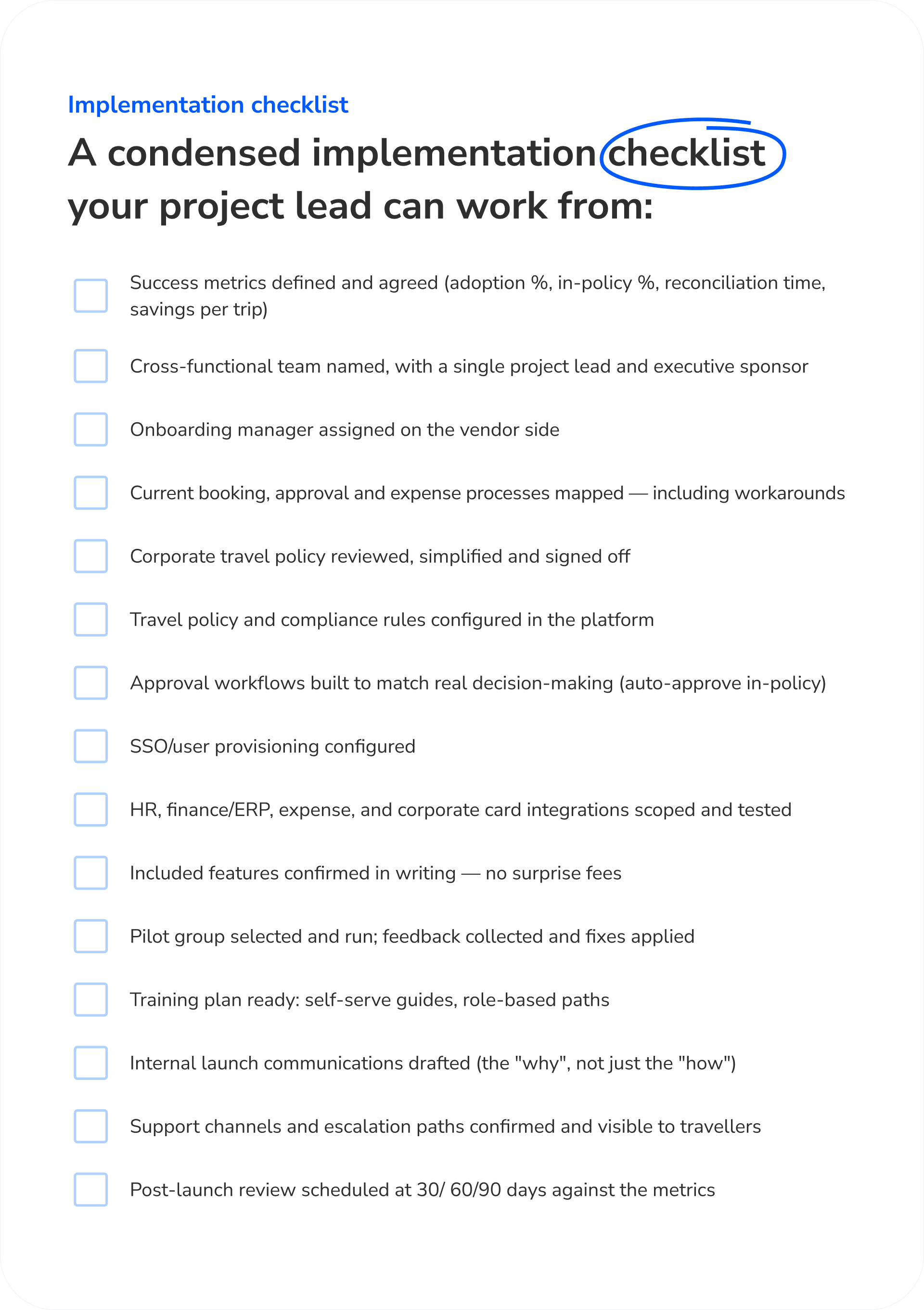
This guide is about getting it right. It walks through how to plan and run a travel management software implementation end to end — the stages, the travel policy and integration prep, the approval workflows that make or break adoption and the rollout tactics that turn a system you paid for into one people choose. Moreover, we prepared an implementation checklist you can drop straight into your project plan.
What is travel management software?
Definition and key features of travel & expense management software
Travel management software is the platform your company uses to book, approve, track and report on business travel in one place.
Most modern platforms combine two functions that used to live in separate tools. The first is corporate travel booking software — the search-and-book layer for flights, hotels, rail and ground transport, with your negotiated rates and policy built in. The second is travel and expense management software, often called T&E management software, which handles what happens after the trip: capturing receipts, categorising business travel expenses, routing them for sign-off and pushing the data to your accounting system.
Put together, a capable business travel management software platform usually covers:
- Booking with corporate rates, preferred suppliers and your corporate travel policy enforced at the point of search.
- Approval workflows that route trips and spend to the right manager automatically, with rules based on amount, destination or trip type.
- Expense tracking with receipt capture, automated categorisation and card-feed reconciliation.
- Travel spend management dashboards that give finance real-time spend visibility instead of a quarterly surprise.
- Reporting on travel policy compliance, savings, supplier performance and unused tickets.
- Duty of care — knowing where travellers are and reaching them quickly when plans change.
- Integrations with your HR system, ERP or accounting software, single sign-on and corporate cards.
The strongest products do not bolt these together. They treat booking and expense as one continuous flow, so a trip that is booked is already half-reconciled before the traveller lands.
Why companies invest in TMS and T&E solutions
Companies don't adopt travel management software because they like software. They adopt it because the alternative — spreadsheets, consumer booking sites and a shared inbox — stops scaling somewhere around the point where travel becomes a real line item.
The recurring drivers are:
- Control over spend. Without a system, travellers book wherever, expense whatever, and finance discovers the cost after the fact. A platform enforces the corporate travel policy at the moment of booking, where it matters.
- Cost savings. Negotiated rates, travel policy caps and fewer last-minute bookings add up. The savings are real, but they are a result of good implementation, not a promise you can assume on day one.
- Real-time spend visibility. Leaders want to see committed travel spend now, not at the month-end close. Travel spend management dashboards replace the quarterly surprise with a live picture.
- Faster, cleaner finance ops. Automated expense tracking cuts the manual reconciliation that ties up finance teams for days every month.
- A better traveller experience. People book travel constantly in their personal lives. If your corporate travel booking software is slower or clunkier than what they use on a Saturday, they will route around it — and your data and compliance go with them.
The honest framing: a TMS is infrastructure. Done right, it lets travel keep pace with the business instead of slowing it down. That's the outcome a structured implementation protects.
Why a structured implementation matters
Avoiding failed rollouts and low adoption
Most disappointing TMS projects don't fail because the software was wrong. They fail because the implementation was treated as an IT install instead of a change-management programme.
The failure pattern is consistent. The platform goes live with travel policy rules nobody validated, approval workflows that route to the wrong people and integrations that were "almost done". Travellers hit friction in week one, decide the tool is more trouble than booking direct and quietly go back to their old habits. Six months later, leadership is paying for a platform with 40% travel management software adoption and wondering where the promised cost savings went.
Low travel management software adoption is the single biggest risk in the whole project because every other benefit depends on it. If people don't book in the system, you have no spend data, no travel policy compliance, no duty of care and no savings. A structured rollout exists to prevent exactly this — by validating the configuration before launch, preparing the team and designing for the traveller's experience rather than the admin's convenience.
Benefits of successful software implementation
When implementing travel management software is done deliberately, the gains compound:
- High, durable adoption. Travellers choose the platform because it's genuinely easier, which means your data is complete and your compliance is real.
- Enforced policy without friction. Approval workflows and travel policy controls run quietly in the background. Compliance stops being a fight between managers and travellers.
- Predictable, visible spend. Finance gets real-time spend visibility and clean expense tracking, so travel spend management becomes proactive instead of reactive.
- Measurable cost savings. Negotiated rates and travel policy adherence translate into savings you can actually report.
- Less administrative drag. Fewer manual bookings, fewer chased receipts, fewer "where is this person" emergencies.
- Room to scale. A platform that's properly embedded grows with headcount and new markets without a fresh implementation project every time.
None of this happens by accident. It's the payoff of treating the rollout as a project with stages, owners and success metrics.
Best practices for implementing travel management software
A solid travel management software implementation moves through a predictable set of stages. You can compress the timeline — modern platforms like Tumodo have largely killed the old six-to-twelve-week implementation cycle — but you can't skip the thinking.
Stage 1 — Define goals, scope and success metrics. Before anyone touches configuration, agree on what success looks like. Adoption rate at X days. Percentage of bookings in-policy. Time-to-reconcile at month-end. Average cost savings per trip. Write the numbers down. A project without metrics can't tell whether it worked, and stakeholders will fill the vacuum with their own definitions.
Stage 2 — Build the cross-functional team. Implementing business travel management software is never just an IT task, especially in the case of Tumodo, where the client does not need to provide any IT resources at all. Name a lead from travel/operations, a finance sponsor (for expense and approval rules) and an executive sponsor who can break ties.
Stage 3 — Audit current processes and travel policy. Map how travel is booked, approved and expensed today, including the unofficial workarounds. Review your corporate travel policy line by line: which rules are real, which are aspirational and which are out of date. This is the moment to simplify. Every rule you carry into the new system is a rule someone has to follow and you have to enforce.
Stage 4 — Configure the platform. Translate the audited travel policy into the system: fare and hotel caps, advance-purchase rules and the compliance logic that flags or blocks out-of-policy choices. With Tumodo, you can build the approval workflows to match how decisions are actually made — most spend should auto-approve in-policy, with exceptions routed to a named approver who gets a fast request. Over-engineered approval chains are an adoption killer; design for the common case.
Stage 5 — Handle integrations. Plan early for single sign-on (SSO/SCIM) so access provisioning is automatic, HR data for org structure and approver hierarchy, expense and accounting/ERP systems for clean expense tracking and reconciliation.
Stage 6 — Pilot with a real group. Don't go from configuration to company-wide launch. Run a pilot with one department or region — ideally frequent travellers who'll stress-test the booking flow, the approval workflows and the support experience. Collect their friction points and fix the configuration before scaling. A pilot turns assumptions into evidence.
Stage 7 — Roll out with onboarding and training. Plan the company-wide launch as a communicated event, not a silent switch. Pair software onboarding with role-based employee training (more on adoption tactics below), clear comms on the "why", and visible support for the first weeks. The first booking experience sets the tone for everything after it.
Stage 8 — Measure, iterate, optimise. After launch, watch your stage-one metrics. Where is adoption lagging? Which travel rules generate the most exceptions (a sign the policy, not the traveller, may be wrong)? Where do employees contact support most? Feed those findings back into configuration.
Strategies to drive compliance and satisfaction
Adoption is won or lost in the weeks around launch. These are the methods that consistently move travel platform adoption up and keep travellers — and finance — satisfied.
Explain the why, not just the rule. People comply with systems they understand. A short, honest launch message — what's changing, why it helps them (faster booking, real support, no expense-report archaeology) and what's expected — does more for adoption than any mandate. Treat travellers as partners, not as a compliance risk to be managed.
Lean on a dedicated manager during ramp-up. A dedicated onboarding consultant who knows your setup is the difference between questions that get answered in minutes and questions that become reasons to abandon the tool. This is why platforms built for fast adoption — Tumodo among them — assign a real person to your launch rather than handing you a knowledge base and wishing you luck.
Back it with responsive customer support. Nothing erodes adoption like being stranded — a missed connection, a hotel that lost the booking, an approval stuck on a Friday night. Reliable, fast customer support is an adoption strategy, not just a service line. When travellers learn they'll get a real human quickly, they trust the system enough to keep using it. Tumodo's standard here is a live specialist responding in 30 minutes or less, around the clock — because the support experience during a problem is what people remember.
Keep travel policy simple and current. A corporate travel policy that's short, clear and regularly reviewed is easier to follow and easier to enforce. Revisit it as the business changes. Every exception your approvers process is a small tax on satisfaction; a cleaner policy reduces that tax for everyone.
Conclusion
A travel management software implementation is won or lost on discipline, not features. Clear goals, a real cross-functional team, an honest look at your corporate travel policy, integrations planned early, a pilot before the full launch, and a go-live built around the traveller rather than the administrator — that's the difference between a platform people trust and one they quietly route around.
Do that, and the returns compound: durable adoption, travel policy compliance that runs quietly in the background, expense tracking that reconciles itself, real-time spend visibility for finance, and cost savings that materialise because people are genuinely booking in the system. And above all, travel that moves at the speed of the business — so growth is never waiting on the process meant to support it.
If you're choosing or rolling out a platform, Tumodo gets most companies live within 24 hours, includes every feature in a single price — approvals, reports and integrations, no add-ons — and pairs your launch with a dedicated onboarding manager and live human support that responds in 30 minutes or less. Book a demo to see what a fast, well-supported implementation looks like.
FAQ
- What is travel management software and why implement it?
Corporate travel management software is the platform a company uses to book, manage and report on business travel in one place — combining corporate travel booking with travel and expense management software. Companies implement it to replace scattered bookings, personal cards and manual receipts with a single system that enforces the corporate travel policy at the point of booking, automates expense tracking and gives finance real-time spend visibility. The payoff is tighter travel policy compliance, cleaner financial data, measurable cost savings and a faster experience for travellers — travel that keeps pace with the business instead of slowing it down. - How long does travel management software implementation take?
It depends almost entirely on the provider's model. Traditional corporate travel management software often runs a 6–12 week implementation, treated as an internal IT project with integrations and configuration on your team's shoulders. A platform with a dedicated consultant who handles setup, integrations and software onboarding for you can compress that to days. Tumodo gets most companies to their first booking within 24 hours of contract because a named onboarding manager builds the configuration rather than handing you a setup guide. The realistic variable is not the software — it is how much the vendor does with you versus hands to you. - What are key steps in a travel management software rollout?
A reliable rollout moves through clear stages: audit your current state and define success metrics; assign a single internal owner and pull in finance, IT and HR early; clean up and simplify your corporate travel policy before encoding it; configure the platform and build your approval workflows; connect integrations and verify the data against your ledger; pilot with one team before going wide; deliver role-specific training; then phase the go-live team by team, closing off the old booking channels as you go. The implementation checklist in this article maps each of these steps for travel, finance and IT to track. - How do you drive employee adoption of a new TMS?
Travel management software adoption comes down to making the platform the easiest path, not just the mandated one. Build the corporate travel policy into the booking flow so the compliant choice is also the fastest, close off the old booking channels as each group goes live and keep approval workflows quick so people are not punished for using the system. Back it with live training for daily users and real customer support that answers in minutes when a trip breaks. Travel platform adoption holds when speed, ease and fast help are all present — the same things that make travellers happy are what keep them inside the system. - What are common challenges during implementation?
Three recur.
Integration is the most common technical failure point — connecting HR, your ERP or accounting system, single sign-on and corporate card feeds, usually because it was left until late instead of involving IT early.
Approval workflows are a balance: too rigid and people route around them, too loose and you lose control over business travel expenses.
Training and adoption is the quiet one — the platform works, but travellers default to old habits because employee training was thin or the old path stayed open.
Each is a process and change-management problem, not a software defect. - How does travel management software integrate with expense tracking?
The strongest platforms treat booking and expense as one continuous flow rather than two bolted-together tools. Because the trip is booked inside the system, much of the expense data — supplier, amount, cost centre, policy status — is already captured before the traveller returns. Corporate card feeds reconcile transactions automatically against those bookings, and the categorised data pushes into your ERP or accounting system. That is what separate travel and expense management software, or full T&E management software, is built to do: turn business travel expenses into clean, reconciled records with real-time spend visibility, instead of a pile of receipts finance chases at month-end. - What metrics should we track after implementation?
Set your benchmarks before go-live, then measure against them. The core set: online booking rate (share of trips booked in-platform), travel policy compliance rate, time-to-reconcile (how fast business travel expenses close) and realised cost savings from negotiated rates and fewer out-of-policy bookings. Add adoption by team or route so you can find and fix where travel platform adoption lags, and use your travel spend management dashboards for real-time spend visibility into where money goes. Treat these as a continuous management view, not a one-time go-live report — the first 90 days of tuning are where the value gets locked in.