The capital of Qatar has grown, in barely a generation, from a quiet pearling port into one of the Gulf's most efficient business destinations.
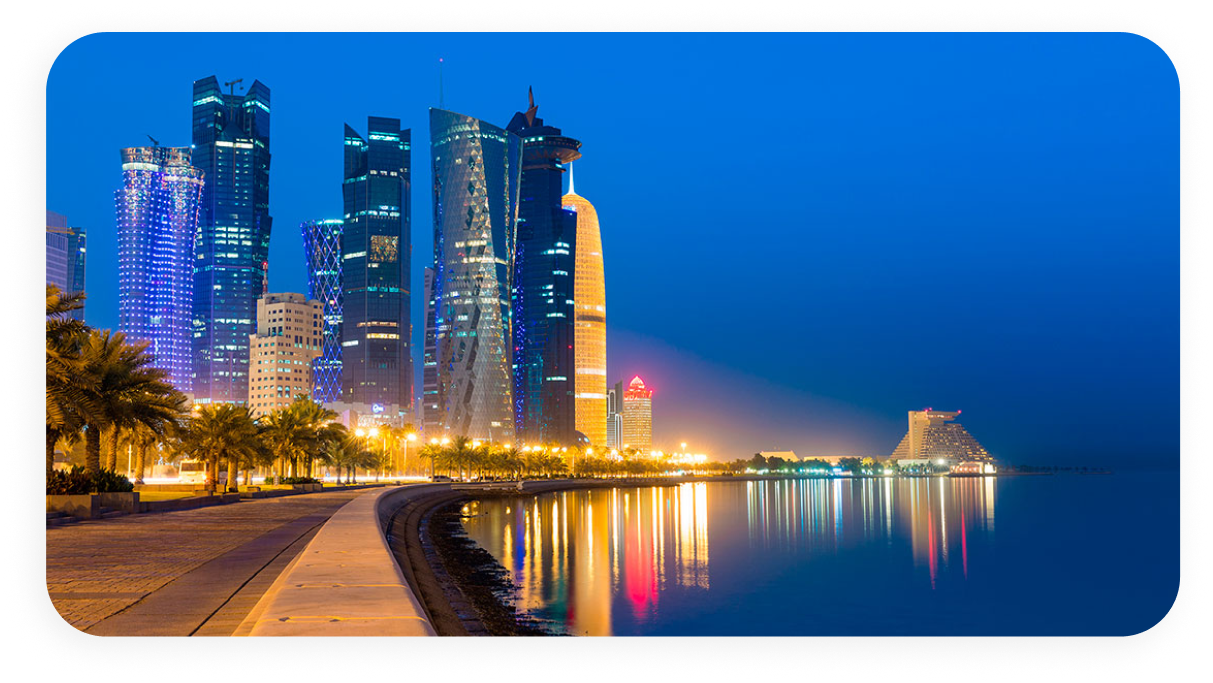
The skyline of West Bay, a driverless metro and a city built around large-scale conferences and global brands all reward visitors who plan well. The cultural register is more conservative than in many other regional hubs and the working week starts on Sunday rather than Monday — but the practicalities of a corporate trip here are unusually smooth. This guide walks through everything to sort before you fly, on arrival and across a typical week of meetings.
Read more of Tumodo corporate travel guides.
Before you go
A corporate trip to Doha is logistically easy if you handle a few specifics in advance: the right entry permit for your passport, a calendar adjusted to the Gulf working week and a quick orientation on local norms. Here's what to settle before you board.
Visa and entry requirements
Qatar runs one of the most open entry regimes in the region, but there are three different routes into the country depending on your passport — and they're easy to mix up. Here's how each works.
Visa-free entry (visa on arrival)
Around 95 nationalities — including the EU member states, the UK, the US, Canada, Australia, Japan, South Korea, Singapore — can enter Qatar without applying for anything in advance. You arrive at Hamad International, present your passport at immigration and receive a free or low-cost entry stamp valid for 30 days (longer for a smaller group of nationalities), extendable once for the same period.
GCC nationals (Saudi Arabia, UAE, Bahrain, Kuwait, Oman) enjoy the most flexible access of all and need only their passport or national ID.
eVisa
If your nationality isn't on the visa-free list, the traditional route is an eVisa, applied for online before travel through the Ministry of Interior portal. It's Qatar's standard short-stay visa, just delivered electronically. The application asks for a passport scan, a photo, a confirmed return ticket, proof of accommodation and sometimes proof of funds; processing usually takes a few business days. You print or save the approval and present it on arrival. An eVisa is typically valid for 30 days and extendable once for a fee.
Hayya entry permit
The Hayya platform is a parallel online route that began life as the entry system for the 2022 FIFA World Cup and has since evolved into a permanent permit programme.
It has three different categories:
- Hayya A1 — Tourist permit. The standard option for international visitors coming to Qatar for tourism, sightseeing or short business visits like meetings and conferences. Available to travellers from over 90 nationalities, valid for up to 30 days and extendable once for a fee. In practice, it functions as a simplified tourist eVisa.
- Hayya A2 — Event attendee permit. Issued for travellers attending a specific approved event in Qatar. Tied to the event dates and usually requires a confirmation or invitation from the event organiser as part of the application.
- Hayya A3 — Family visit permit. For close family members of Qatar residents coming to visit them. The Qatar-based resident sponsors the application.
Time zone and scheduling
Qatar runs on Arabia Standard Time (AST), UTC+3, with no daylight saving — so the offset is constant year-round. That puts Doha two hours ahead of Central Europe, three ahead of the UK, half an hour behind India and the same time as Moscow, Riyadh and Nairobi. Most flights from Europe arrive in the evening, which makes a buffer day before meetings worthwhile if you've come from further afield.
The biggest scheduling adjustment for many visitors is the working week: in Qatar it runs Sunday to Thursday, with Friday and Saturday as the weekend. Sunday is a normal working day; Thursday is the equivalent of Friday elsewhere. Typical office hours are around 8:00 to 17:00, and most government offices, banks and corporate counterparts will be unreachable on Fridays and partially on Saturdays.
Friday midday is sacred: Friday Jummah prayers happen around midday and almost everything — including the metro for a short window — pauses for them. Avoid scheduling meetings on Fridays, plan around shorter hours during Ramadan (typically six working hours a day) and check the Eid holidays (Al-Fitr in spring, Al-Adha in early summer), which can compress business activity for up to a week.
Money and payments
The currency is the Qatari Riyal (QAR). Doha is overwhelmingly cashless: contactless cards, Apple Pay and Google Pay are accepted almost everywhere — hotels, restaurants, taxis, malls, even most small cafés. Visa and Mastercard work universally; American Express is more limited but accepted in upper-tier hotels and restaurants.
Still, carry some cash in QAR for the occasional taxi driver, small souk vendor or tip. ATMs are plentiful in the airport, malls and bank branches; notify your bank of travel dates to avoid blocks.
Tipping isn't expected but is appreciated: 10–15% is fine at restaurants if a service charge isn't already added (it often is) and small change is welcome for porters and drivers. One quirk to keep in mind: alcohol is taxed heavily (around 100%) in licensed hotel restaurants, which makes business dinners with wine notably more expensive than in most other capitals.
Internet and apps
Connectivity in Doha is excellent — nationwide 5G, fast hotel Wi-Fi and reliable mobile coverage anywhere in the metro area. For a short trip, an eSIM activated before departure is the easiest option; if you prefer a physical SIM, Ooredoo and Vodafone both have counters at the airport and offer competitively priced tourist SIMs.
A handful of apps make the city much easier to navigate:
- Karwa Taxi — the government-backed turquoise taxi fleet; metered, regulated and the only cars allowed to pick up directly at the airport rank.
- Uber — works across Doha with transparent app pricing; cashless by default.
- Qatar Rail — for live metro information, route planning and tickets.
- Talabat and Snoonu — the two main food delivery platforms, with Snoonu a strong local favourite.
- WhatsApp — the default channel for confirmations with hotels, drivers and local contacts.
WhatsApp voice and video calls work normally in Qatar, which is a useful difference from some neighbouring countries.
Accommodation: rules and tips
For business, the choice of neighbourhood matters more than the choice of brand. The four main areas to consider:
- West Bay — Doha's central business district, lined with tall hotels (Four Seasons, St. Regis, Hilton, Kempinski, Sheraton, Shangri-La). The natural base if your meetings are in corporate offices or the Qatar National Convention Centre area.
- Msheireb Downtown Doha — a newly built, walkable district that mixes traditional Qatari architecture with modern design; close to Souq Waqif and excellent metro connections.
- The Pearl — an upscale artificial island with marina-side dining, leisure-oriented but increasingly used by visiting executives who prefer a calmer base.
- Lusail — the brand-new planned city north of central Doha; good for trips tied to Lusail Stadium events or new development meetings.
A few practicalities: check-in is typically at 3 pm and check-out noon, you'll need your passport at the desk. Quoted rates usually exclude VAT and a 10% service charge — confirm whether prices are inclusive so your expense report doesn't get a surprise. Alcohol is only available in licensed hotels, so if a working dinner with wine is a part of your plan, book accordingly.
Business etiquette and local norms
Qatari business culture is built on hospitality and relationships, at a more measured pace than visitors from the other parts of the world may be used to. Meetings typically open with Arabic coffee (gahwa) and dates, and the unhurried small talk that follows — about your journey, your family, the city — is part of the work, not a filler. It's how trust is built before substance. Decisions often route through hierarchy, so patience reads as competence.
A few practical points:
- Greetings. Same-gender handshakes are firm but unhurried. With the opposite gender, let your counterpart lead — a nod with a hand to the heart is the standard alternative if a handshake isn't offered.
- Right hand only. Use it for greetings, business cards, eating and gesturing. Cards are exchanged two-handed or right-handed and it's worth pausing to read one before putting it away.
- Names and titles. "Sheikh" and "Sheikha" refer to members of the ruling family and senior dignitaries; don't use them casually. Otherwise "Mr/Ms" with the first name ("Mr Ahmed") is the safe default — copy whichever form your counterpart introduces themselves with.
- Dress. Conservative and well-turned-out: jackets for senior meetings, modest coverage of shoulders and knees for women. Locals wearing thobes and abayas don't expect you to dress as they do — only to respect the same modesty.
- What to avoid. Religion and regional politics as conversation topics; photographing people without their permission; and during Ramadan, eating, drinking, or smoking in public during daylight hours, whether or not you're fasting.
How to get to Qatar
International travel
Reaching Doha is rarely the hard part of a trip here: Hamad International is one of the world's best-connected hubs and a flagship for Qatar Airways' global network. The decisions worth thinking about in advance are which routing makes sense from your part of the world, whether you fly direct or connect and when to lock in fares.
Air connections
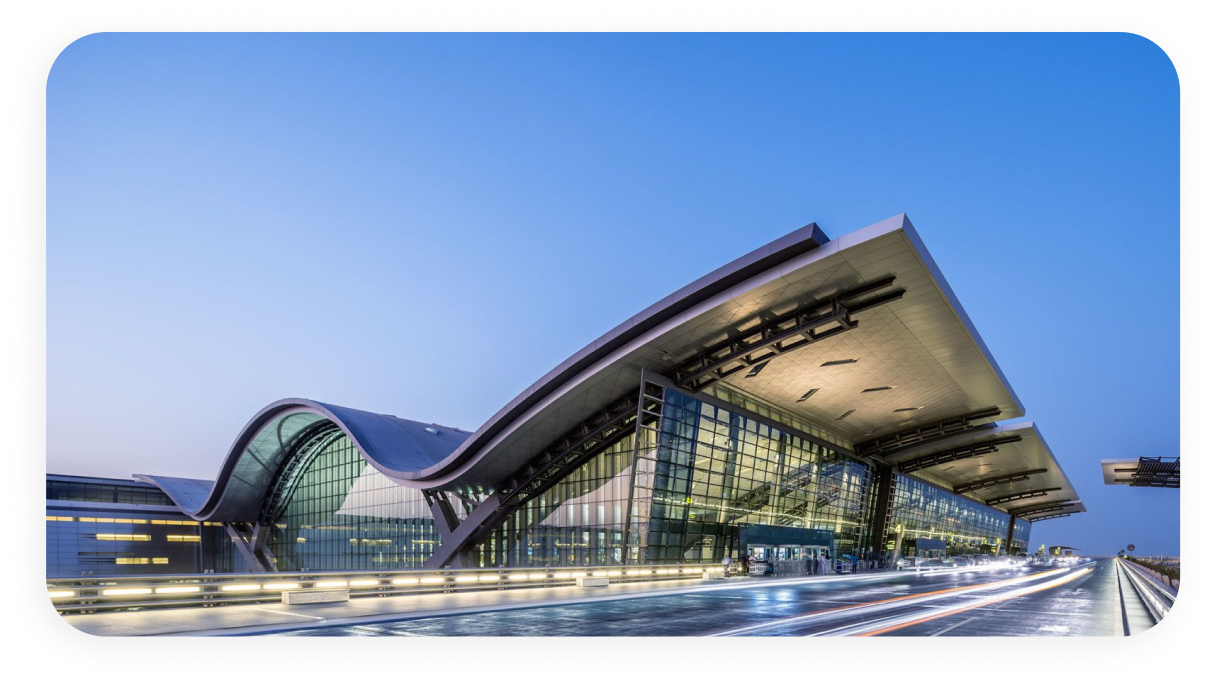
The gateway is Hamad International Airport (HIA / DOH), located about 15 km south-east of central Doha — closer than most major international airports — and consistently ranked among the world's best for service and design. The airport has two terminal complexes:
- Terminal 1, the main passenger building shared by Qatar Airways and most international carriers;
- Terminal 2 for low-cost and seasonal traffic.
Almost all corporate travellers arrive at Terminal 1.
Qatar Airways, the national carrier and a oneworld member, dominates DOH with one of the most extensive long-haul networks in the world, reaching roughly 170 destinations across six continents.
Foreign carriers serving Doha directly include the other major Gulf and regional airlines — Emirates (Dubai), Etihad (Abu Dhabi), Saudia, Oman Air, Turkish Airlines (Istanbul) — plus selected European and Asian airlines such as British Airways, Lufthansa, KLM, Air France, Singapore Airlines, Cathay Pacific and the major Indian and Chinese carriers. Direct service from the US and Australia is largely a Qatar Airways monopoly.
In practical terms, Doha has direct flights to most major hubs across Europe, Africa, the Middle East, South and East Asia, Australasia and (via Qatar Airways) North and South America. If you're flying from Europe, the Gulf, India, or South-East Asia, a direct flight is almost always available.
Connecting flights
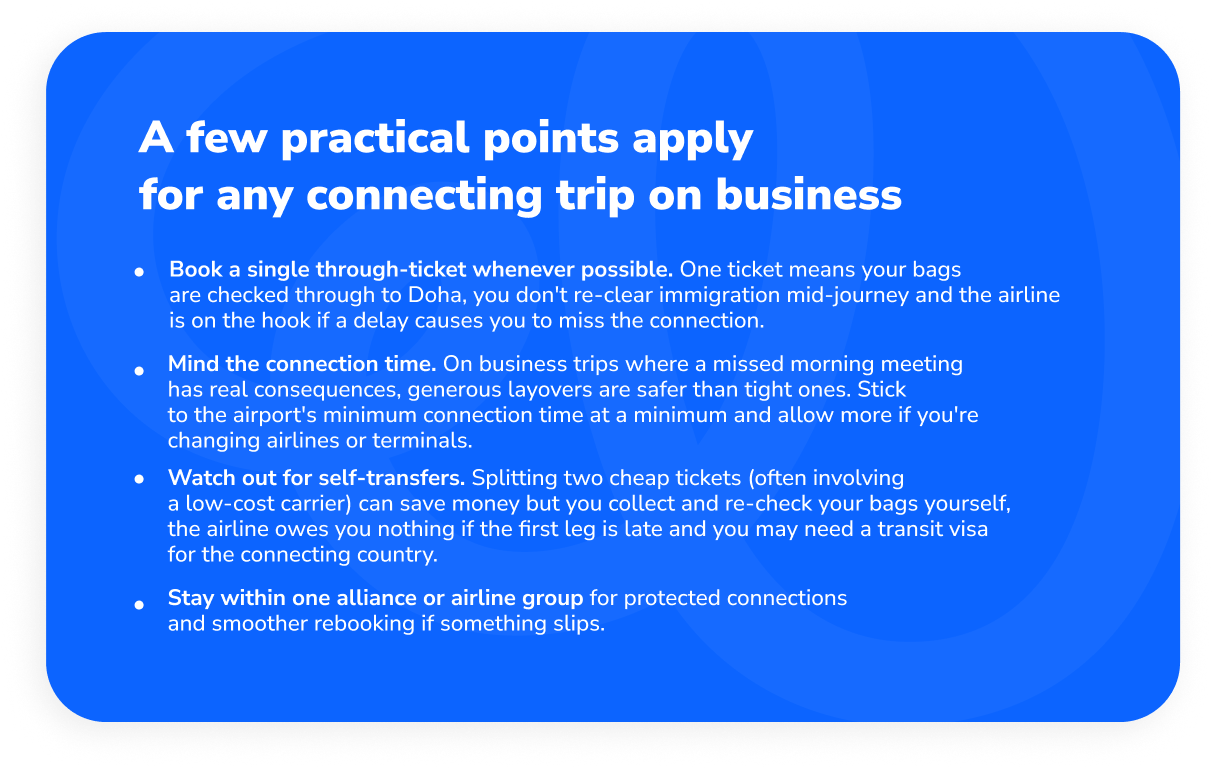
Where a direct flight isn't on offer, Doha is easy to reach with one stop. The most efficient one-stop routings tend to go through the major Gulf hubs (Dubai, Abu Dhabi, Riyadh, Jeddah, Muscat), Istanbul or major European gateways (London, Frankfurt, Paris, Amsterdam) and East Asian hubs (Singapore, Hong Kong, Bangkok). From Africa and Latin America, the connection is usually through Europe or the Gulf.
When to book
For long-haul international flights to Doha, the sweet spot is usually two to three months ahead — enough to lock in good fares without committing before meeting dates are firm. For trips during peak periods, book earlier.
A few peaks are worth flagging on the calendar. Late autumn through early spring is the high season for Doha — the weather is pleasant, conferences cluster around this window and both flights and hotels fill up. Ramadan and the two Eid holidays (Eid Al-Fitr in spring, Eid Al-Adha in early summer) shift each year on the lunar calendar; flights connecting through the Gulf get tight just before and after. Major events at Lusail, the Qatar Economic Forum, the Doha Forum and large industry conferences also push demand hard — book flights and hotels together once dates are confirmed.
Two habits help control cost and risk: set a fare alert on your route once dates are roughly known and for business travel favour flexible or refundable fares even at a premium, since meeting schedules shift and a change fee usually outweighs the saving on a restricted ticket.
From Doha airport to the city centre
Hamad International is unusually close to central Doha — about 15 to 17 km — so even at the worst of traffic the trip to a city-centre hotel rarely takes more than half an hour. You have several options for how to make it.
By metro
The Doha Metro Red Line runs directly from Hamad International Airport Terminal 1 to the heart of the city and for many travellers it's the fastest and cheapest option. A single ticket costs just QAR 2 (around €0.50), the trains are modern, fully driverless and air-conditioned and they run every six minutes or so. From the airport station to Msheireb (the main interchange where all three lines meet) takes around 14 minutes.
By bus
Mowasalat public buses (route 747 in particular) run from the airport Bus Pavilion to Al Ghanim bus station near Souq Waqif and other points in the city. Fares are very cheap (around QAR 10 with a Limited travel card) but the ride takes 40–45 minutes with multiple stops, and luggage space is limited. Mainly useful for the very budget-conscious or solo travellers with light bags.
By taxi or car transfer
The official airport taxi fleet is Karwa — the turquoise metered cabs operated by the state-owned Mowasalat company. They are the only cars permitted to pick up directly at the airport rank, located at the Taxi Pavilion just outside Arrivals.
For a corporate trip, the more comfortable option is often a pre-booked private transfer. Most four- and five-star hotels offer their own airport transfers — confirm at booking. For executive arrivals, this is the smoothest option: no queues, no surprises and predictable expense reporting.
Getting around Qatar
Within the city, three modes cover almost every business itinerary: the metro, taxis and ride-hailing and driving. Walking works in pockets — Msheireb, the Corniche, parts of The Pearl — but the heat for most of the year (often 35°C+ from May to October) makes long walks impractical outside winter.
Driving and parking
Doha is built around the car. The road network is modern, well-signposted in English and Arabic and well-lit, with multi-lane expressways linking the airport, West Bay, Lusail and the suburbs. Driving is on the right, international driving permits are recognised for short visits, and rental cars are easy to pick up at the airport or from city offices. Fuel is cheap by global standards.
A few cautions for visiting drivers: traffic in central Doha and on the Corniche can be heavy at rush hour (around 7:00–9:00 and 16:00–19:00), local driving style is faster and more assertive than in much of Europe, and speed cameras are dense. Parking is easy and usually cheap in malls and most hotels (often free for guests), but central streets in Souq Waqif, Msheireb and West Bay get crowded — paid garages and valet are the simpler choice. For a typical executive trip with one or two meeting venues a day, a hire car is often more friction than it's worth; taxis or pre-booked drivers leave you free to read or take calls.
By metro and tram
The Doha Metro is the easiest way to cross the city quickly and skip traffic. Three lines operate:
- Red Line ("Coast Line") — runs north–south from Al Wakra through central Doha to Lusail, with a branch to the airport. Stops at West Bay, Katara, Qatar University and the airport itself.
- Green Line ("Education Line") — runs east–west through Education City and the universities.
- Gold Line ("Historic Line") — east–west across central Doha; the line to take for Souq Waqif and the National Museum.
All three meet at Msheireb, the main interchange.
The system is air-conditioned, fast and immaculately clean; single tickets are QAR 2 ($0.55), a day pass is QAR 6 ($1.64), and rechargeable travel cards make repeat trips easier. Trains run from early morning to around midnight (later on weekends), with a short pause on Friday mornings for prayers.
There are three travel classes — Standard, Family and the premium Goldclub — and tickets come from vending machines or service counters at the station. Goldclub costs a few times more but gets you a quieter, more comfortable carriage.
Taxis and ride-hailing
Outside the metro, Karwa taxis are the everyday workhorse — easy to flag down on the street, queue for at hotels and malls, or book via the Karwa app. Fares are metered: city rides typically run QAR 15–40, and most cars now accept card payments.
Uber is the main app-based alternative. A reasonable strategy is to keep both apps on your phone and use whichever has the shorter wait, with Karwa as the more affordable default and Uber as the convenient backup.
Walking, buses and water transport
In the cooler months (November to March), central Doha is genuinely walkable in stretches: the Corniche, the Msheireb–Souq Waqif axis, the MIA Park and the marina-side promenades of The Pearl and Katara are all pleasant on foot. Bring water and respect the shade.
Mowasalat city buses form a comprehensive but slow network, mainly used by commuters; for visitors, they're cheaper than taxis but rarely the best use of time. Finally, abras and water taxis run short hops along the Corniche and out to MIA Park — more atmospheric than practical, but a nice way to take a break from car traffic.
Where to stay in Doha
Waldorf Astoria Doha West Bay
Location
The Waldorf Astoria Doha West Bay sits within a ten-minute walk of City Centre Shopping Mall and the Doha Corniche, placing it squarely in West Bay — the city's primary commercial district and home to the majority of corporate headquarters. The DECC metro station is within a few blocks of the hotel, offering connections across the city without relying on a car. The Doha Exhibition and Convention Centre is roughly a kilometre away, making this an especially practical base for delegates attending major conferences or trade events.
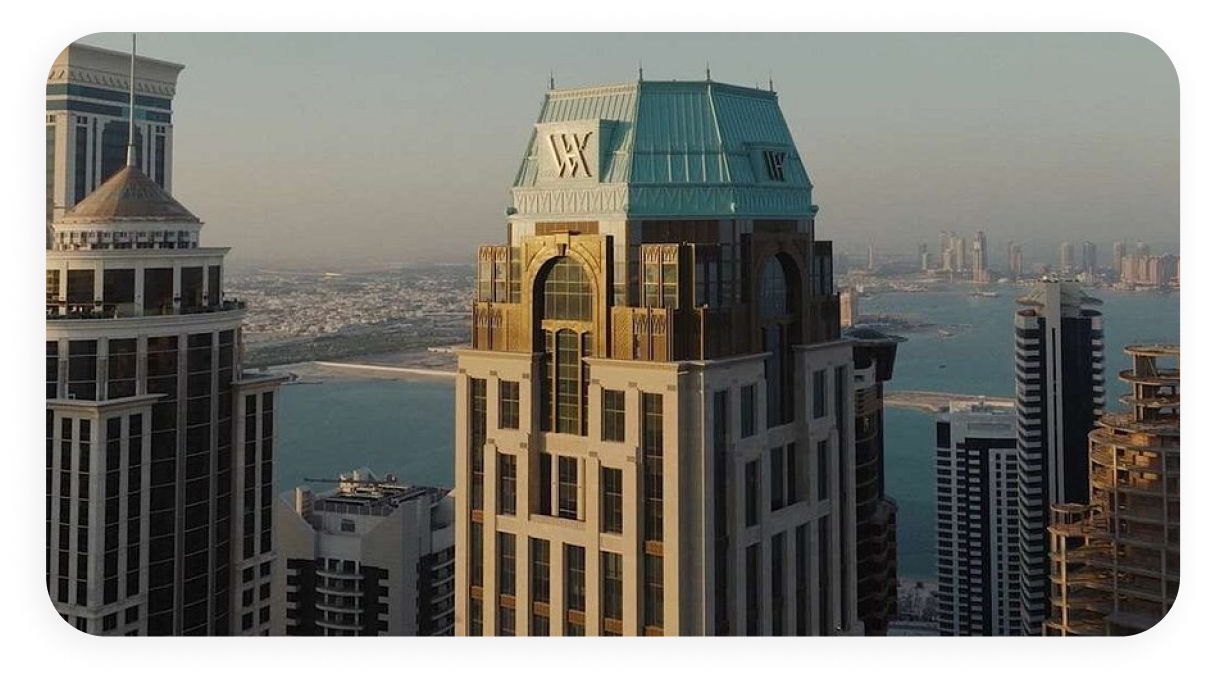
At the hotel
The 44-storey property features 283 rooms and suites, as well as 50 luxury apartments finished in an Art Deco design style. Rooms come with Smart TVs, premium bedding, rainfall showers and complimentary Wi-Fi throughout.
Meeting and events space includes two ballrooms, each capable of hosting up to 500 guests, plus two boardrooms and three multi-functional meeting rooms with access to an outdoor patio. A dedicated business centre rounds out the conference offering.
For downtime, the four-floor Waldorf Astoria Spa and Fitness centre features treatment spaces, sauna and steam rooms and one of the largest indoor pools in the city with panoramic views. Dining options include the Michelin-recommended Muru restaurant and the signature Peacock Alley for afternoon tea.
W Doha
Location
W Doha is located in West Bay, with the DECC metro station approximately 880 metres from the hotel — a short walk that connects guests directly to all major rail lines. City Centre Mall is immediately adjacent, and the Doha Exhibition and Convention Centre is reachable in a few minutes by car or taxi. The position suits business travellers who want to be close to Doha's commercial core while remaining well connected for evening dining and cultural excursions.
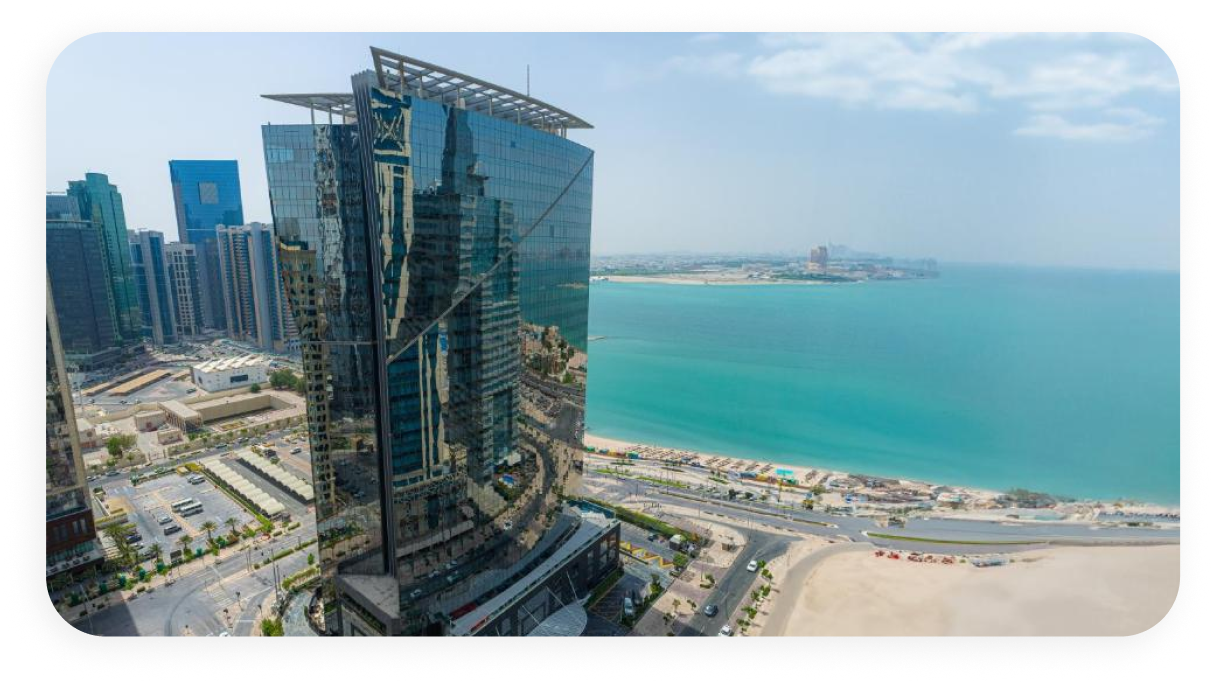
At the hotel
W Doha has 442 rooms, all featuring 24-hour room service and laptop-friendly workspaces, along with air conditioning and bathrobes. For events, the hotel offers a Great Ballroom that can accommodate up to 350 guests, plus three additional meeting rooms for up to 50–60 people each, all with natural daylight. The WIRED Business Centre is amply outfitted with PC and Mac workstations, printer, copier, scanner, audiovisual and telecommunications equipment and high-speed internet.
Leisure facilities include the Bliss Spa — the only one of its kind in the Middle East — an outdoor pool with private cabanas, a 24-hour gym, sauna and hammam. Three internationally acclaimed restaurants are on site, including Market by Jean-Georges and Spice Market.
Riviera Rayhaan by Rotana Doha
Location
Riviera Rayhaan by Rotana is centrally located in Doha, within walking distance of Bin Mahmoud metro station, which provides easy connections to West Bay, the Corniche and other key business districts. Souq Waqif and the Doha Corniche are within a five-minute drive, and the Museum of Islamic Art is nearby — useful for client entertainment. The central position makes this a strong choice for travellers attending meetings across multiple parts of the city.
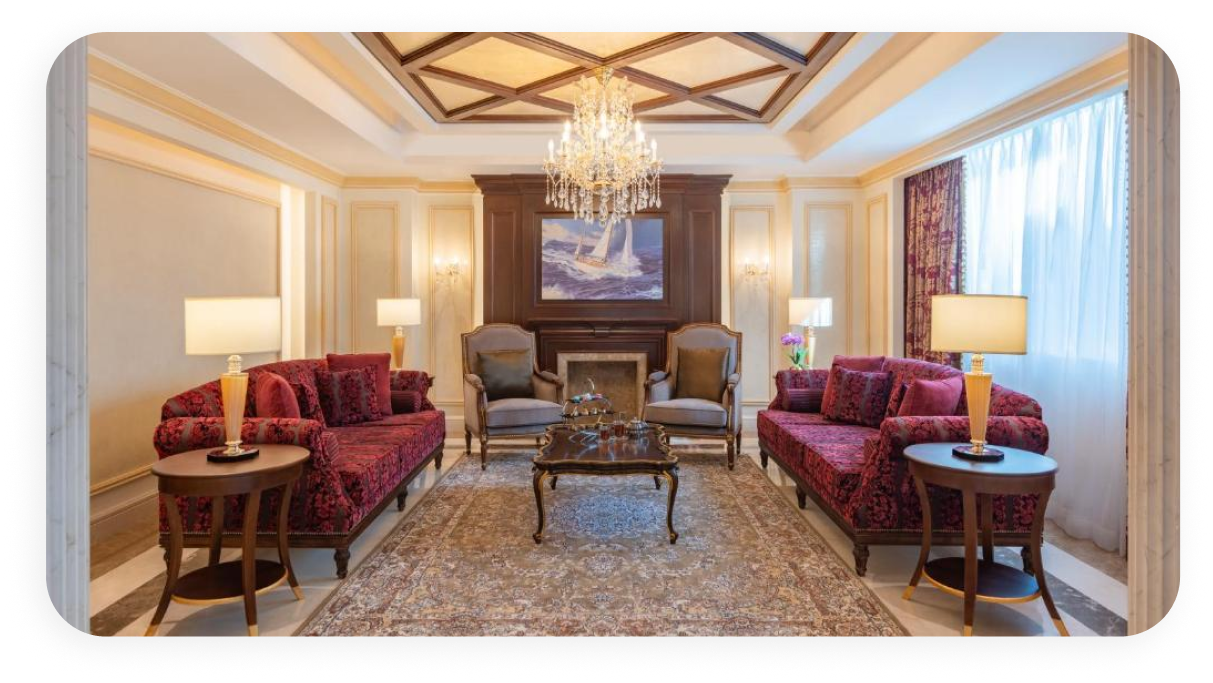
At the hotel
The hotel has 185 air-conditioned rooms featuring minibars, flat-screen televisions and complimentary wired and wireless internet access. Each room is also equipped with a work desk and coffee machine. Business facilities include a 24-hour business centre and approximately 140 square metres of conference space across three meeting rooms.
Leisure amenities include a rooftop outdoor pool with city views, a spa, sauna, hot tub and fitness centre. The on-site Salvia All Day Dining restaurant specialises in Mediterranean cuisine and also functions well for informal working lunches. Free private parking and a limo/town car service are available on request.
Ezdan Hotel West Bay
Location
Ezdan Hotel West Bay sits just off the Corniche in the Al Dafna area, with the West Bay metro station roughly 550 metres away — a short walk that puts guests on the Red Line and within easy reach of all major business districts. The Doha Exhibition and Convention Centre is a five-minute walk from the property, and City Centre Mall is within a 20-minute stroll. Free on-site parking is a practical bonus for those travelling between meetings by car.
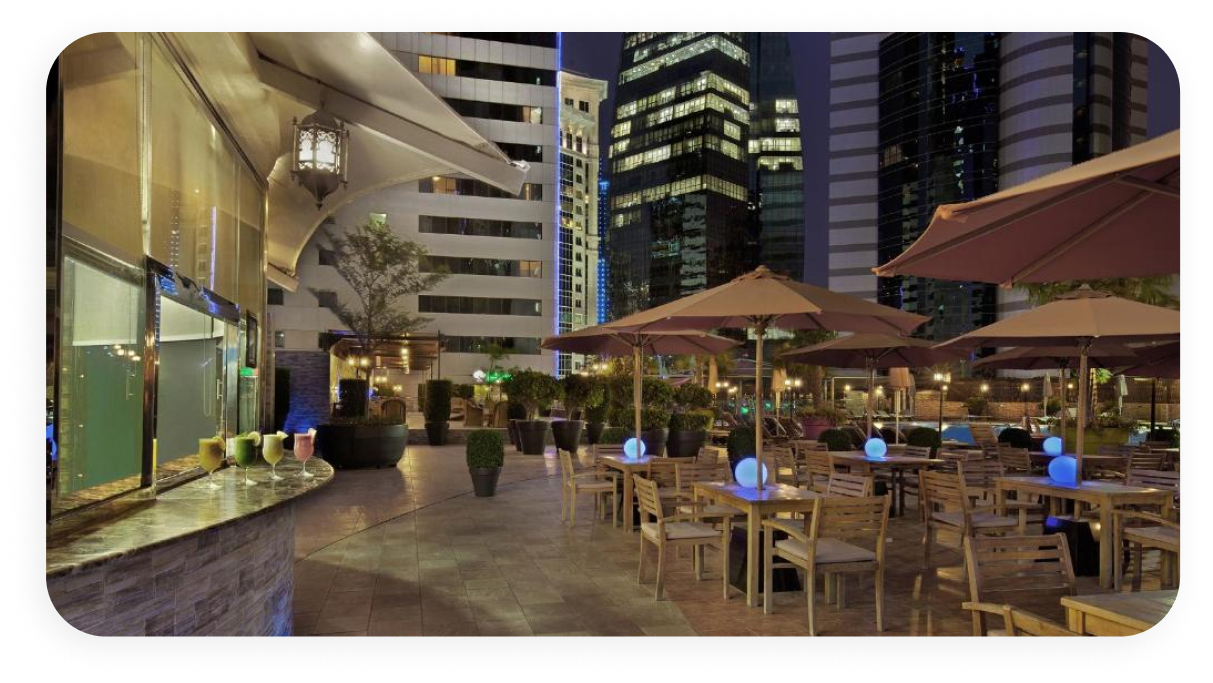
At the hotel
Billed as the largest hotel in Qatar, Ezdan Hotel West Bay offers 3,000 rooms and units ranging from standard rooms to three-bedroom apartments — an unusually broad range that makes it a strong fit for both overnight stays and longer corporate assignments. Rooms are equipped with air conditioning, flat-screen satellite TV and complimentary wired internet throughout. Business facilities include a fully equipped conference centre, a dedicated business centre and meeting rooms available for group sessions.
Leisure amenities include an Olympic-size swimming pool, a health club with fitness classes, steam room, Jacuzzi, sauna, full spa and a children's play area. An on-site supermarket adds a practical convenience rarely found in a hotel setting. Four dining outlets are available, including the Al Thouraya restaurant serving international cuisine, plus a poolside bar.
Ibis Doha
Location
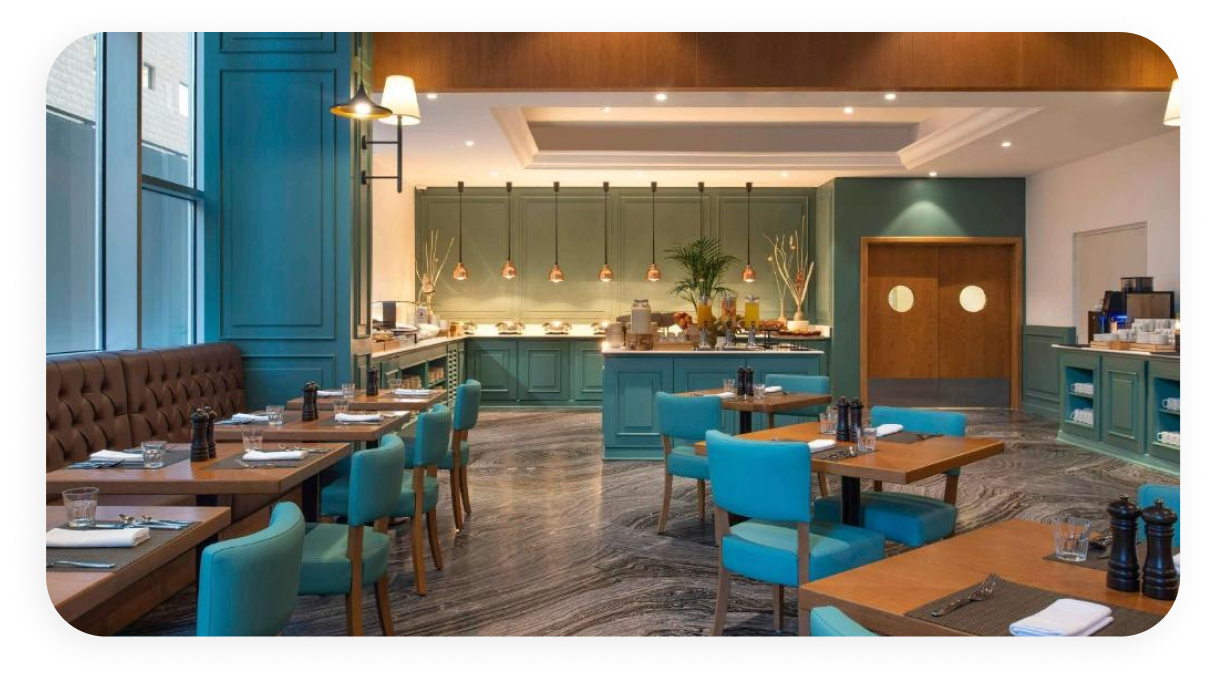
Ibis Doha is located in the Rawdat Al Khail area, roughly a 15-minute drive from Hamad International Airport and a short ride to the city centre and key business districts. The hotel sits near Grand Hamad Stadium and is within convenient reach of Souq Waqif and the Museum of Islamic Art. While not in the immediate commercial core, its competitive rates and straightforward access via Ring Road make it a sensible pick for cost-conscious business travellers who don't need to be in West Bay every day.
At the hotel
Ibis Doha features 127 air-conditioned rooms with complimentary wireless internet, flat-screen satellite television and a minibar fridge. Rooms are compact but well-configured, with memory foam beds and Smart TVs.
On-site amenities include a free business centre, meeting and banquet facilities, an infinity swimming pool, fitness centre, restaurant and bar. The Charlie's Corner restaurant serves Middle Eastern and international cuisine in a modern, family-friendly setting and works equally well for a quick working breakfast. Free private parking is included for all guests.
Walking route through Doha
If you have a free morning or a half-day between meetings, the most rewarding walking route in Doha runs along the southern Corniche and through the old town. It's roughly 3–4 km and works best in the cooler months or first thing in the morning.
Start at the Museum of Islamic Art (MIA) — the I.M. Pei-designed cube rising on its own island, with one of the world's finest Islamic art collections. The building alone is worth the visit. Take a slow walk through MIA Park behind it, with views back across the bay to the West Bay skyline.
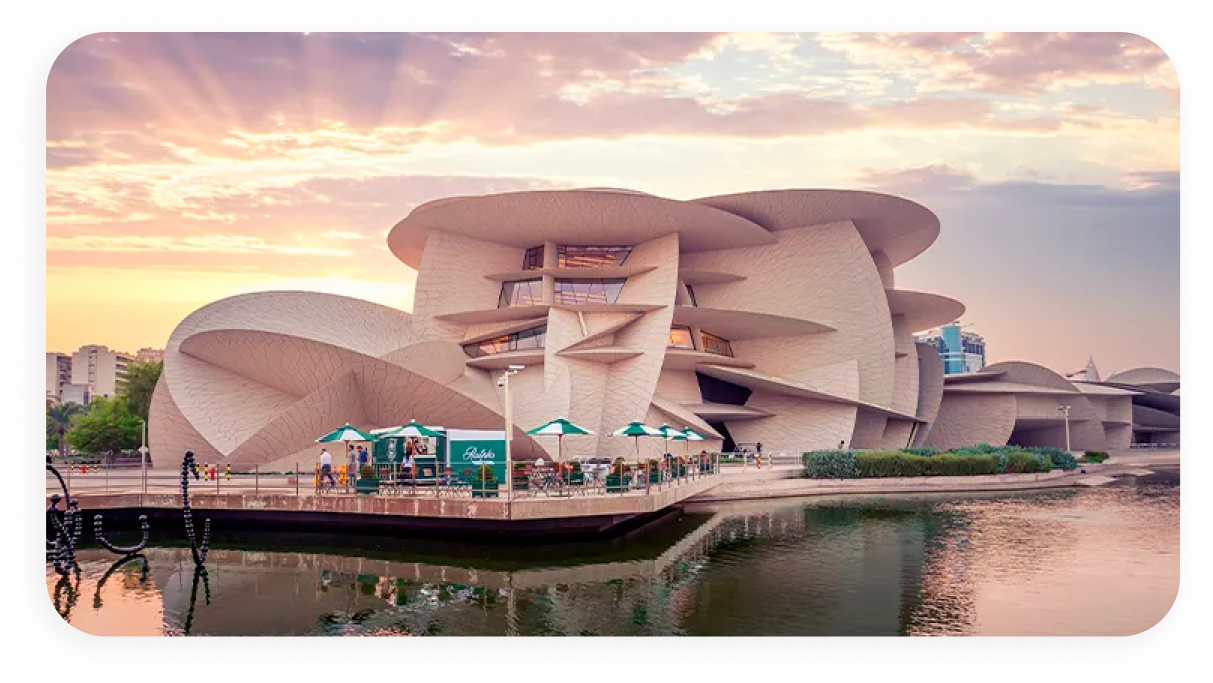
Follow the Corniche west toward central Doha. The seafront promenade hugs a curve of bay, with traditional dhow boats moored along the water and the skyline ahead. After about a kilometre you'll reach Souq Waqif — the rebuilt traditional market and the heart of old Doha. Wander the alleyways: spices and oud perfume in one row, falcons in another, gold and textiles further in. Stop for a mint tea or karak chai at one of the open-air cafés.
From the souq, cross into Msheireb Downtown Doha, the newly built quarter where traditional Qatari architecture has been reinterpreted in clean modern lines. The free Msheireb Museums (four historic houses telling Qatar's story) are excellent and easy to combine. End at Msheireb metro station, from where you can ride the Red Line back to West Bay in a few minutes.
If you have more time, extend with a taxi or metro hop up to Katara Cultural Village — an open-air complex of galleries, amphitheatres and waterfront restaurants — or to The Pearl for a marina-side coffee.
Business-friendly lunch spots in Doha
Doha is a strong restaurant city. Most high-quality business dining happens inside hotels — partly because of the alcohol licensing, partly because the city's best chefs are based there. A short list of reliable choices:
Jamavar
Doha's most celebrated Indian restaurant and one of only two establishments to earn a Michelin star when the Guide first arrived in Qatar in 2024. Jamavar is located at the iconic Sheraton Grand Doha Resort and Convention Hotel on the Corniche and is the second international outpost of the renowned Indian fine-dining concept from LSL Capital. The interiors draw directly from the grandeur of New Delhi's Viceroy's House — warm grey oak panelling, textured chalk-white plaster and intricate mirror and brass details, with the elegant space divided across two refined dining rooms.
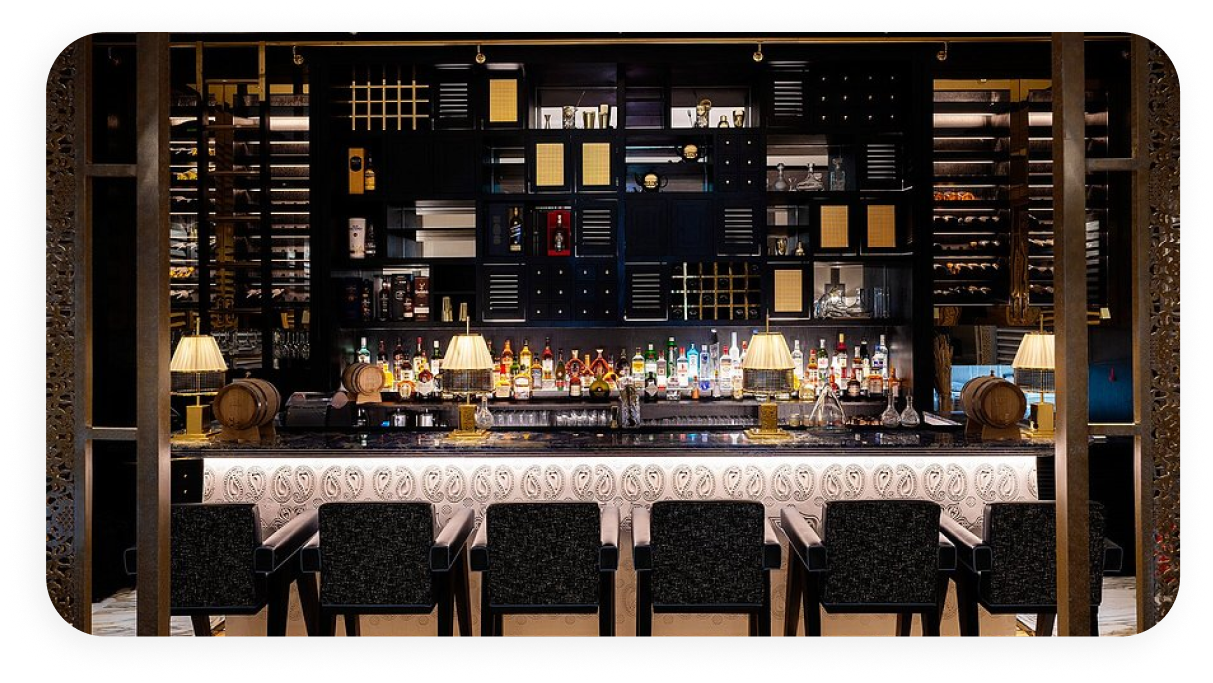
The extensive menu covers all regions of India, from Old Delhi butter chicken to Kerala-style beef, with refined small plates and succulent tandoor dishes including lamb chops. The set business lunch runs Sunday to Thursday from 12:30 pm to 3:30 pm, with a two-course menu at QAR 109 and three courses at QAR 149. Private dining is available for more confidential meetings.
Dress code: Smart casual. Reservations are essential.
Argan
For a lunch that ventures beyond the usual hotel circuit, Argan at the Al Jasra Boutique Hotel in Souq Waqif is the standout choice. A Michelin Bib Gourmand recipient in the 2025 Guide, the restaurant sits on a pedestrianised street on the fringes of the Souq Waqif marketplace. The menu features authentic Moroccan dishes packed with flavour and careful spicing, with tagine and couscous as the specialities. Desserts such as jawhara are excellent, as are the refreshing mocktails.
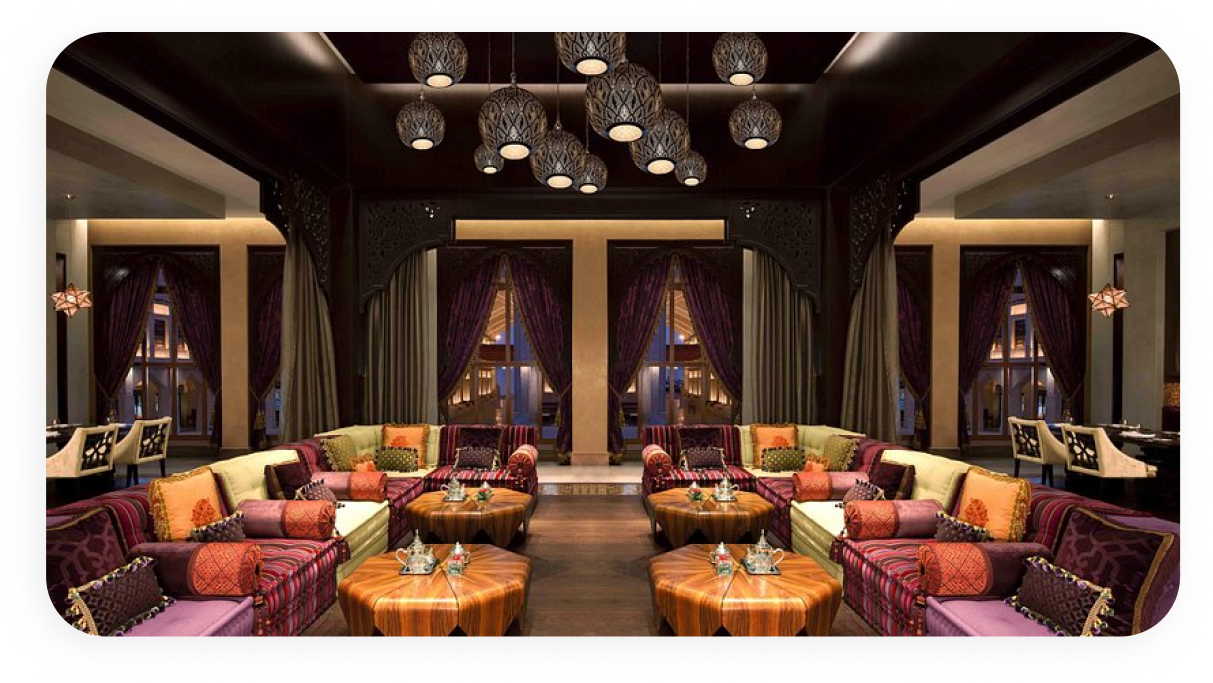
The warmly lit dining room — intricate lanterns, carved woodwork and the aroma of slow-cooked tagines drifting through the air — creates an atmosphere that stands apart from the glass-and-marble formality of most West Bay restaurants, making it a memorable setting for entertaining international clients. The Michelin Bib Gourmand was retained in 2026.
Dress code: Smart casual
GAIA
Perfectly positioned along the waterfront in West Bay, GAIA blends Greek heritage with Mediterranean elegance, from a vibrant main dining room to a serene sea-view lounge, each space thoughtfully designed to reflect the beauty of its coastal setting. Famous Dubai-based chef Izu Ani combines traditional flavours with fresh, seasonal ingredients — from daily catches at the fish market to bright Mediterranean mains. Standout dishes include sea bream carpaccio and a modern take on moussaka.
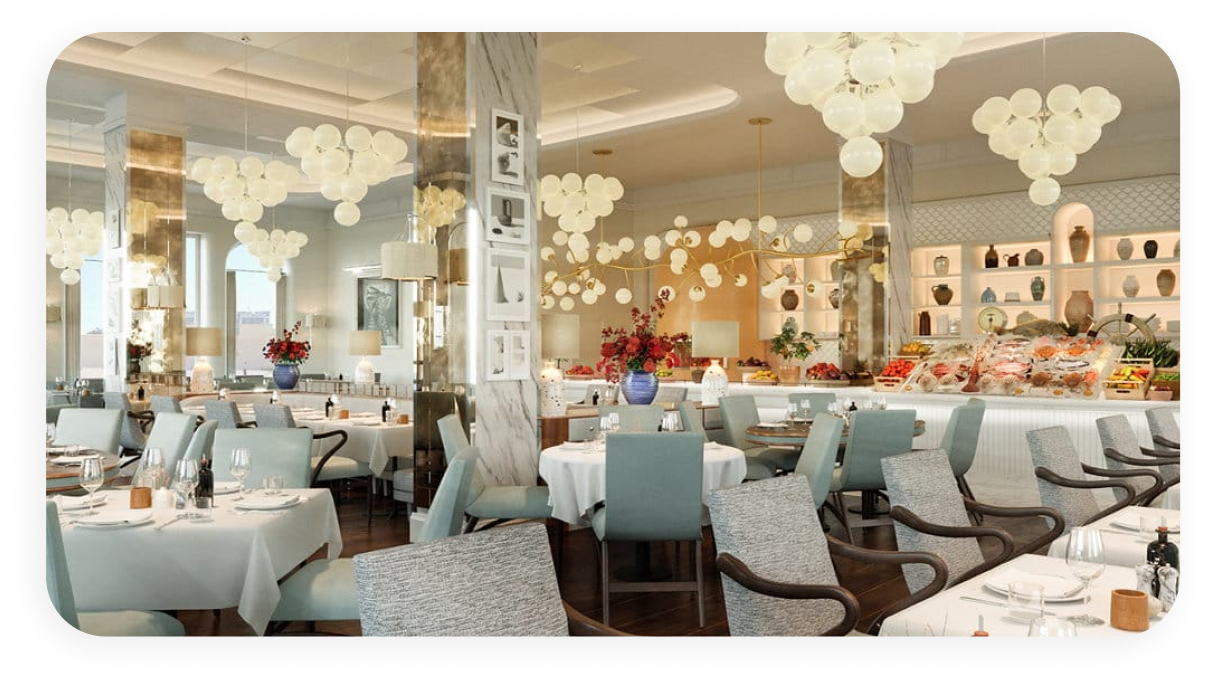
The restaurant's wide windows and open-plan layout make it one of the more visually impressive rooms in the city for a midday meeting, without the heaviness of a formal hotel dining room. Private dining and catering options are available for group events.
Dress code: Smart elegant. Tailored shorts are welcome; sportswear and beachwear are not permitted. Reservations are strongly recommended, particularly for weekday lunches.
Where to relax after work
Doha's evenings reward those who step away from the hotel. The Corniche lights up after dark, the Gulf breeze softens the heat, and the city offers everything from world-class cultural institutions to some of the highest rooftop terraces in the region. Whether you want to decompress quietly or unwind over a drink with a view, the options below are consistently well-rated and well-suited to business travellers.
Mathaf: Arab Museum of Modern Art
Mathaf is the world's largest collection of modern and contemporary Arab art and the first museum of its kind in the region, established in 2010 and located in Doha's Education City. The permanent collection provides a genuinely rare opportunity to encounter Arab modernism — painters, sculptors and conceptual artists from across the Arab world whose work rarely appears in Western institutions — alongside ambitious rotating international exhibitions.
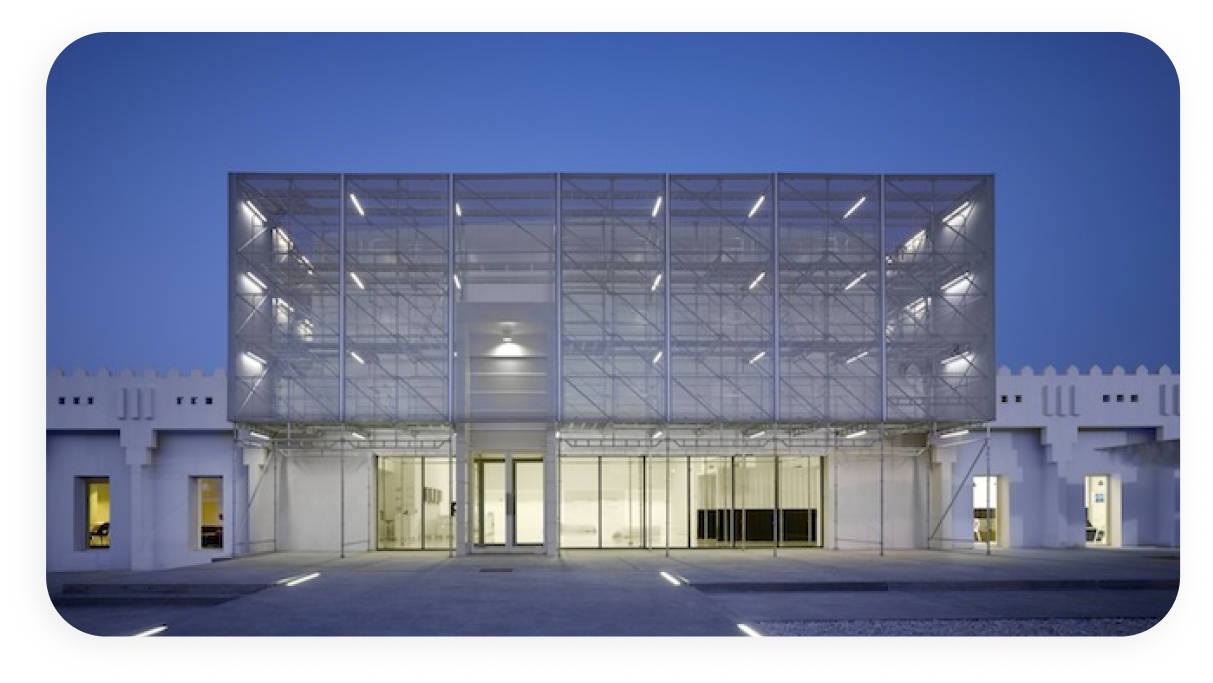
The building has a clean, minimalist design that keeps the focus firmly on the art and it is accessible by metro via the Education City Green Line station, with a three-minute walk from the tram stop. For those with an interest in contemporary art or simply looking for something beyond the usual tourist circuit, it is consistently rated as a highlight by visitors on TripAdvisor. Admission to the permanent collection is free; a small charge applies for temporary exhibitions.
Tropicana 360
Perched on the 48th floor of Dusit Hotel & Suites in West Bay, Tropicana 360 is Doha's highest rooftop terrace, offering uninterrupted 360-degree views across the city and the Arabian Gulf. The space combines a cosy indoor lounge with a large outdoor terrace, and the atmosphere shifts naturally from a relaxed after-work setting in the early evening to something livelier as the night progresses.
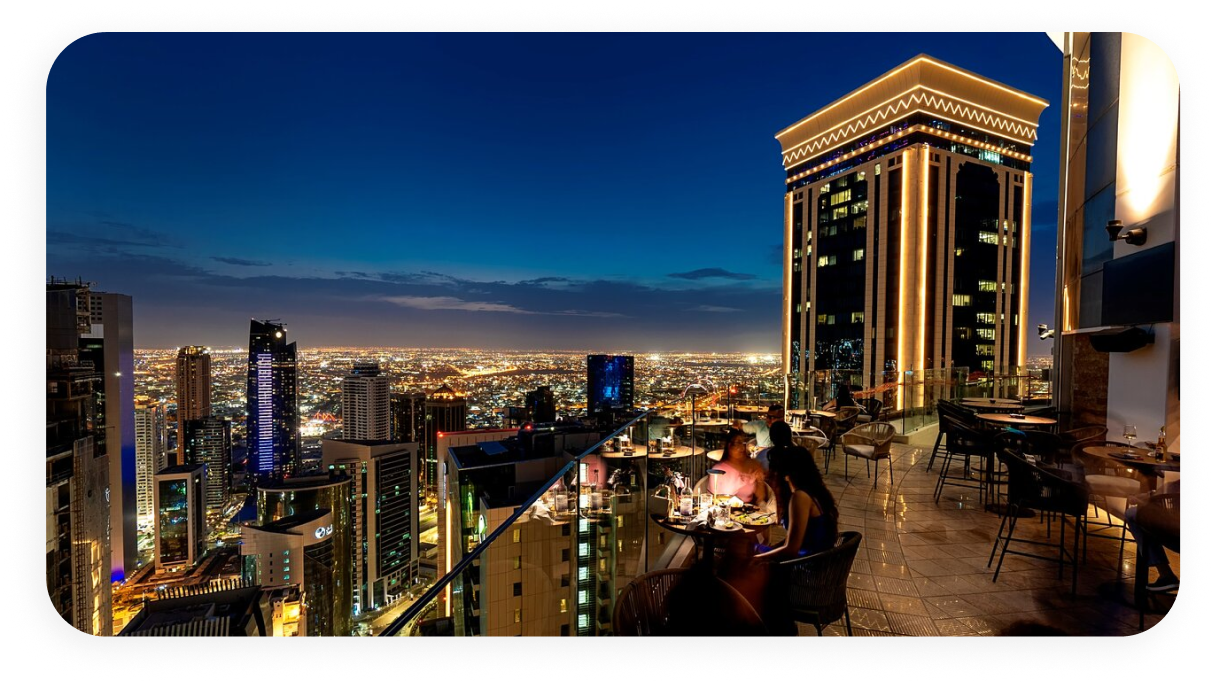
Happy hour runs daily from 4 pm to 8 pm, with beverages and signature bites from QAR 36 — well-timed for heading straight from the office. The menu focuses on pub classics and European cuisine, with shisha available on the terrace. A lively rooftop brunch runs on Fridays. A passport or Qatari ID is required for entry.
Belgian Café
The Belgian Café at InterContinental Doha sits on the waterfront in West Bay and has long been one of the city's most popular spots for sunset drinks and informal post-work gatherings. The terrace faces the Arabian Gulf directly, making it one of the best outdoor settings in Doha when the weather is favourable.
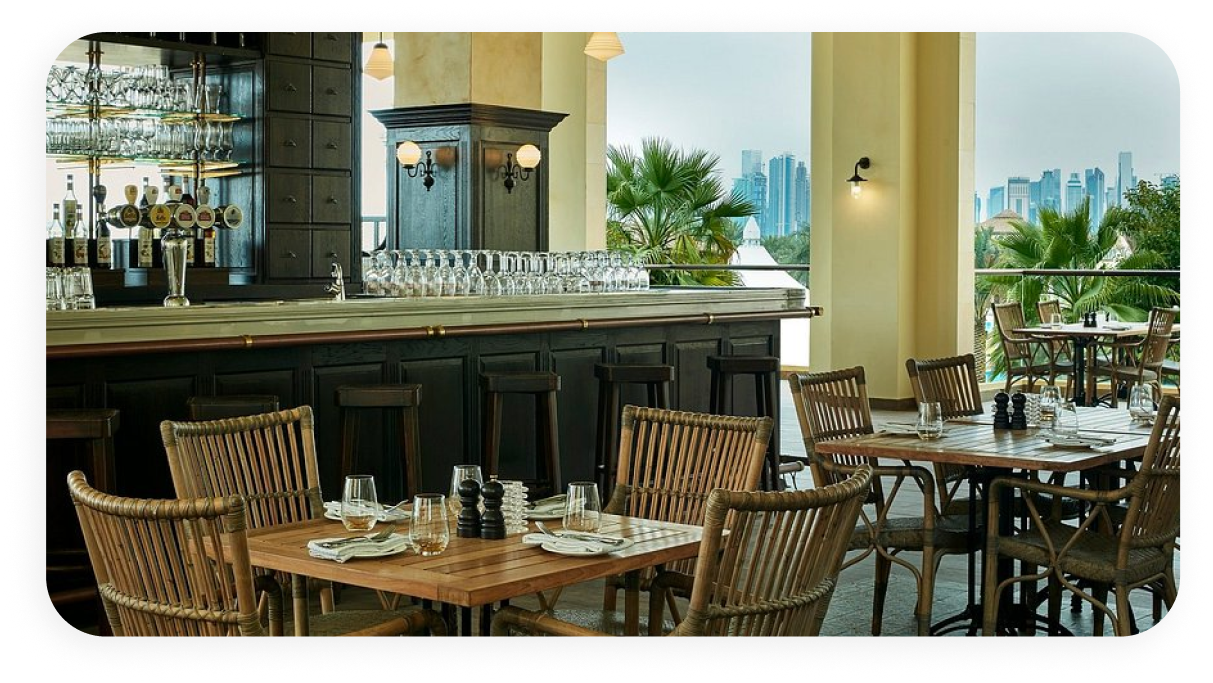
The venue is known for its extensive beer selection — including a well-curated range of Belgian ales — alongside cocktails and a straightforward bar food menu. The atmosphere is reliably convivial without being loud, making it an easy choice for a group wind-down after a long day of meetings.
What to bring back for colleagues
Doha has a strong tradition of hospitality, and the souks make sourcing thoughtful gifts straightforward. The classics:
- Dates — the gift of choice across the Gulf. Bateel is the high-end brand, with beautifully boxed assortments of stuffed gourmet dates; supermarket varieties are also excellent.
- Arabic coffee and a small dallah (the traditional long-spouted coffee pot) — a distinctive memento that travels well.
- Cardamom, saffron and other spices — buy at Souq Waqif's spice alley; ask the seller to vacuum-seal.
- Oud and bakhoor — the distinctive Arabian incense and oil perfumes; even small bottles make impressive gifts.
- Camel milk chocolate — a uniquely Qatari novelty, available at Hamad Airport and major hotel shops.
- Pearls — a nod to Qatar's pre-oil pearling industry; reputable jewellers in the souks and malls sell genuine ones.
- Qatari sweets — date-filled ma'amoul and other small confections from Souq Waqif bakeries.
The duty-free at Hamad International is genuinely excellent and well-organised, so leaving last-minute purchases for the airport is a viable plan.