There are several ways to manage business travel. Some companies organise trips manually, others rely on travel agents, many use online booking platforms, while others work with dedicated travel management systems.
At first glance, each of these approaches can handle the task. But as travel becomes more frequent and processes more complex, the gaps between them become harder to ignore. Different setups lead to different results — in costs, time spent and how easy it is to manage trips day to day.
Let’s compare four common approaches and see how they perform.
Manual booking
How it works
Employees organise business trips on their own, without a centralised system. They search for flights and hotels on different websites, compare options manually, request approvals via email or chat and collect documents from multiple sources after the trip.
In most cases, each trip is managed separately, without a shared structure or consistent process across the company.
Advantages
- Full flexibility in choosing options. Employees get unlimited choice of services and can select any flights or hotels without restrictions.
- Familiar tools and platforms. Most people already know how to use booking websites, so the process is familiar.
Limitations
- No visibility into total travel spend. Booking data is scattered across platforms, making it difficult to track overall costs.
- No consistent control over travel policy. Company rules are not applied automatically and are often hard to check.
- Time-consuming for employees. Searching, comparing and coordinating trips takes time that could be spent on core tasks.
- High risk of errors and missing documents. Manual handling increases the chances of mistakes, lost invoices or incomplete data.
Manual booking is a practical option when business trips are rare and handled on a case-by-case basis. But once travel becomes regular and part of everyday operations, it quickly turns into the least efficient way to manage the process — fragmented, time-consuming and difficult to control.
Online booking platforms
How it works
Online booking platforms are designed for leisure travel and are often used for business trips as well. They provide a simple interface to search, compare and book flights, hotels and other services in a few steps.
However, these platforms focus on the booking itself. Company processes — such as approvals, travel policy and expense tracking — are not built in and need to be managed manually.
Advantages
- Quick and straightforward booking process. Travel options can be found and booked in one place, without additional coordination.
- Broad range of available options. Employees can choose from a wide selection of flights, hotels and services across different providers.
Limitations
- Restricted visibility at company level. Booking data stays within individual accounts, so companies do not get a complete and structured overview of all travel activity.
- Travel policy is outside the platform. Employees make booking decisions independently, and compliance is often checked afterwards.
- Limited price transparency. Rates may already include platform markups, so the final amount is not always clearly tied to the supplier’s original pricing.
- Costs can change during approvals. Options are not held, so the fares may increase while a trip is being reviewed.
Online booking platforms offer speed and convenience at the booking stage. However, when used for business travel, they often leave key parts of the process — control, visibility and coordination — outside the system. As a result, companies face less predictable costs, inconsistent workflows and additional workload for internal teams.
Travel agents
How it works
Business trips are organised through a travel agent who manages bookings on behalf of the company. Employees or travel managers send requests, clarify details and receive travel options prepared by the agent.
All changes, approvals and additional requests are handled through direct communication — typically via email or phone.
Advantages
- Personalised support. A dedicated agent helps with bookings, changes and special requests.
- Less involvement from employees. Most of the coordination is handled externally, so employees spend less time on trip planning.
Limitations
- Slower booking process. Each request goes through an agent, adding extra steps and increasing response time.
- Higher overall cost. Agent services add an extra layer of fees, while the underlying travel options do not necessarily become cheaper.
- Support depends on availability. In urgent situations outside working hours it may take time to reach an agent and resolve issues, which can be critical during a trip.
- Difficult to scale with growing travel volume. As the number of trips increases, manual workflows create bottlenecks and additional workload.
Travel agents can be helpful when companies prefer a more guided, hands-on approach to booking. However, this also means relying on availability and response times, which reduces flexibility in day-to-day travel management. As trips become more frequent, this dependency often slows processes down and makes it harder to maintain consistency and control.
Travel management platforms
How it works
Travel management platforms bring all parts of a business trip into one system. Booking, approvals, travel policy, documents and reporting are handled within a single interface, without switching between tools.
Employees can plan trips directly within the platform, while company rules and processes are applied automatically in the background.
Advantages
- All bookings in one place. Flights, hotels and other services are managed within a single system, without switching between platforms.
- Built-in travel policy. Company rules are applied during booking, so employees see only compliant options.
- Real-time visibility into travel spend. Companies can track expenses as they happen and understand where the budget goes.
- Centralised documents and reporting. All invoices and travel data are stored in one place and are easy to access; reports are generated automatically in the required format.
- Faster approvals and structured workflows. Approval processes are built into the platform, reducing the need for additional coordination.
What to consider
- Initial setup and adjustment. The platform needs to be configured to match company processes, and teams may need some time to get used to a new way of working.
- Unlike other approaches, travel management platforms are designed specifically for business needs. They bring structure to processes that are often fragmented across tools, emails and providers, turning them into a seamless end-to-end workflow.
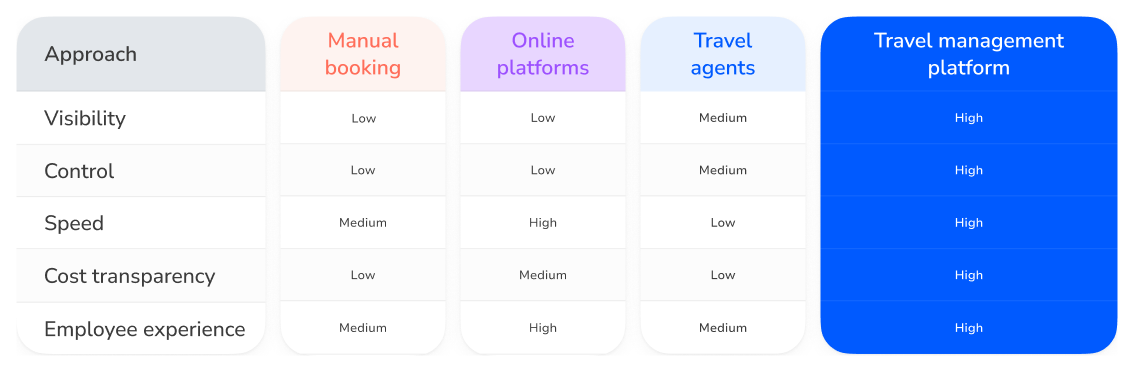
Each approach solves part of the problem. But only one brings all elements together in a consistent way.
How Tumodo helps simplify business travel
Tumodo brings all aspects of business travel into a single platform — from booking to reporting. It helps companies organise trips faster, reduce manual work and keep full control over travel processes and spend. By automating routine tasks and centralising data, Tumodo makes business travel easier to manage for everyone involved — employees, managers, finance teams and leadership.
The Tumodo approach delivers measurable results:
- up to 90% less time spent on organising trips
- up to 35% lower travel costs.
All travel in one place. Access flights, hotels and other services at suppliers’ rates in a single system, without switching between tools.
- Flights with 500+ airlines
- 3.5M+ accommodation options
- Car transfers in 90+ countries
- Trains across Europe and Asia
- Additional services: Fast Track, Meet & Assist, visa support, VIP lounges and more
Everything included in the price. Many platforms charge separately for the features you assume you'd bought; with Tumodo, if it exists in the product, you can use it.
- Approvals, reports, integrations, analytics and support all come in a single plan.
- No per-seat add-ons, no modules to unlock later.
- That keeps your travel budget predictable and procurement simple.
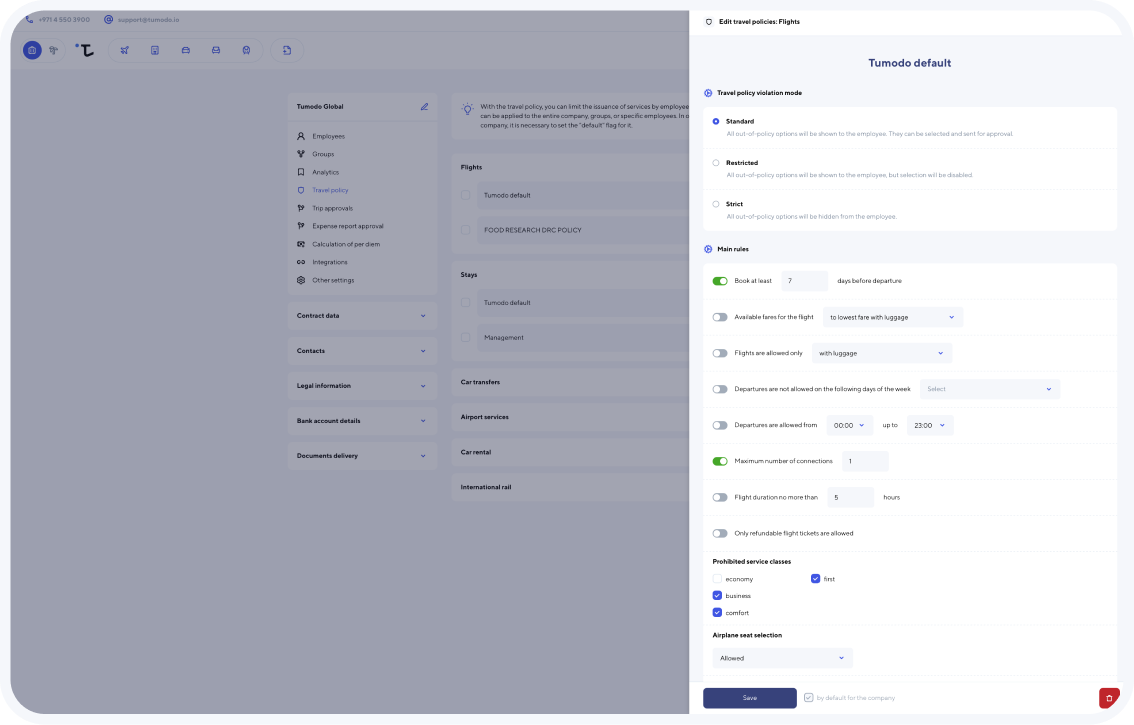
Flexible travel policy. Company rules are built directly into the booking process and can be tailored to your needs.
- Define everything from cabin class and number of stopovers to hotel star ratings and taxi categories.
- Apply rules by route, service type or traveller group to reflect how your company actually operates.
- Employees see only options that match company travel policy, without manual checks.
Simple and fast approvals. Approval workflows are clear, flexible and easy to manage.
- Full trip details available for review in one place.
- Approve requests in one click via email, messenger or the app.
- Service pricing can be held while a trip is being reviewed, so costs remain the same.
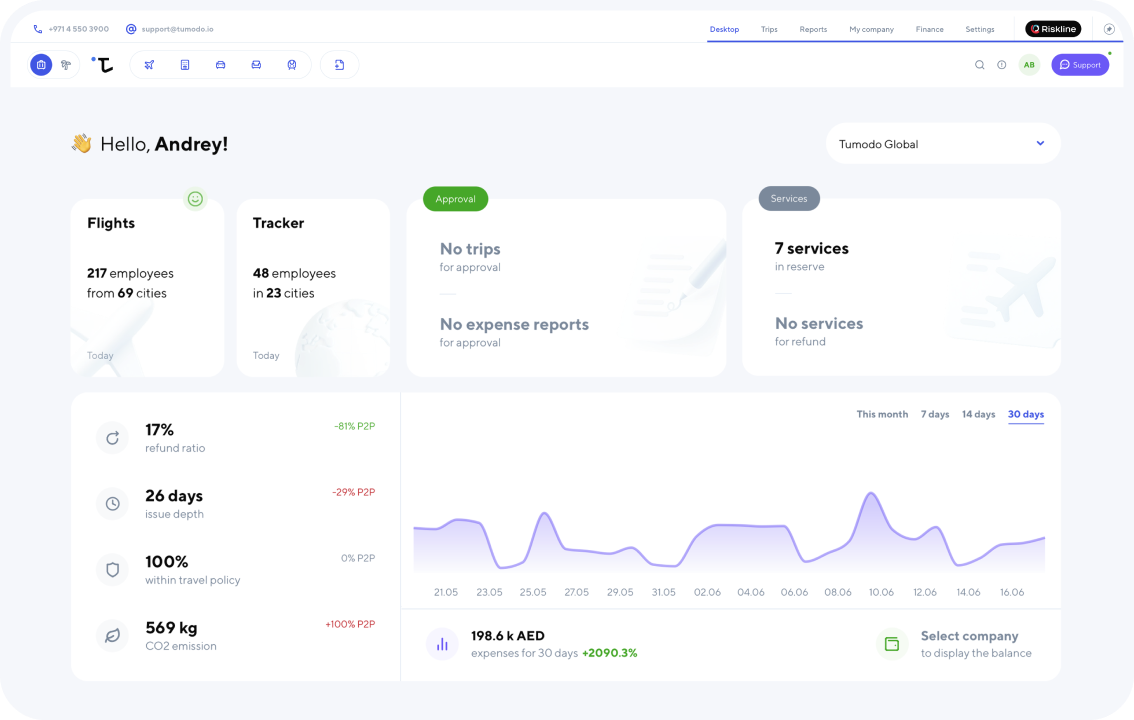
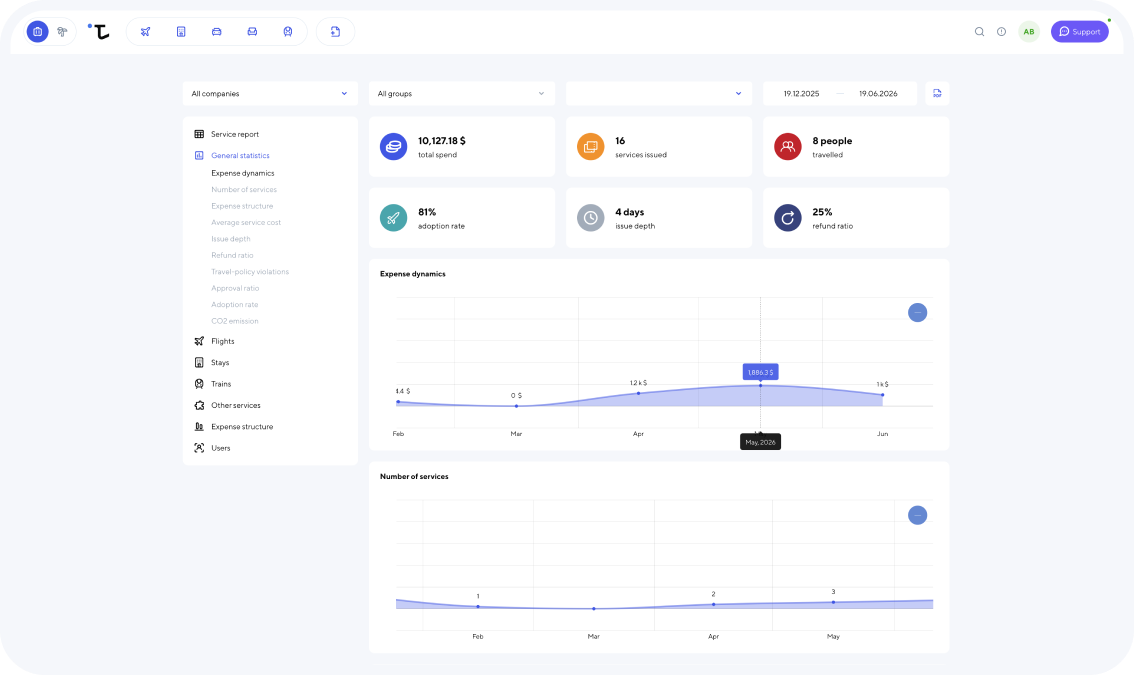
Clear spend visibility and flexible analytics. Understand your travel spend in real time and analyse it from different angles with clear, visual insights.
- Track expenses across all trips in one place.
- Break down data by departments, services, time periods or individual employees.
- Access structured reports for better decision-making.
- Insights are presented in a clear, easy-to-read format and are available to export.
Integrated with your systems. Travel data flows automatically into your HRIS and accounting tools.
- Data is filled in automatically — no manual entry, typos or inconsistencies.
- Documents stay aligned across systems.
- Reports are generated in just a few clicks.
Fast setup and tailored workflows. The platform is configured to match your company structure and processes — the Tumodo team handles the launch for you.
- Setup takes just one day, so you can start using the platform without long implementation cycles.
- We adapt the system to how your teams already operate, without forcing you to change internal processes.
- Our managers run onboarding sessions, host webinars and provide personalised guides for your team.
- The interface feels intuitive from the start and works in a familiar way, similar to everyday booking tools.
Convenient mobile app. Everything travellers need is always at hand, right from their phone.
- All trip details in one place: tickets, vouchers and itineraries are easy to access at any time.
- Book, manage and approve trips directly from the app, without switching devices.
- Receipt scanner to capture and store paper documents on the go.

Reliable support at every stage. Get help whenever it is needed.
- 24/7 support helps with complex bookings, individual requests and urgent situations.
- A dedicated key account manager who supports your team, helps optimise processes and stays in touch as your needs evolve.